NBA Finals Betting Glossary for UK Bettors: From Chalk to Series Price
 Available in US

Why a glossary written by a UK analyst looks different from a US one
A friend asked me to point him at a good NBA betting glossary recently and I sent him three. He came back and asked why they all explained moneyline as if he had never bought a fractional ticket in his life. The answer is that almost every NBA betting glossary you find online is written for a US audience, where moneyline pricing is the default and fractional odds are the exotic format. UK bettors come at the same vocabulary from the other direction – fractional is the default, decimal is familiar, American is the foreign format that needs translation.
This glossary covers the terms a UK NBA Finals bettor actually encounters on UK-licensed apps and in UK-focused content, with the context that matters in 2026. Some of these terms are US imports that have crossed into UK usage; others are UK-specific terms that US bettors will not recognise. With the Thunder priced at -175 to -180 across UK books for the 2026 title, the Spurs at +300 to +320, and the Cavaliers having moved from +5000 to +2000 after their Game 7 win over Detroit, every term in this list has been doing real work in 2025-26 UK NBA markets – which is the framing I have used throughout.
Core terms every UK NBA bettor needs
Chalk is the heavy favourite. Calling a bet “the chalk” means you have taken the obvious favourite at short odds – the Thunder at -175 to -180 is the chalk for the 2026 title. The term comes from the chalk used to mark up odds on old British racecourse boards, where the favourite’s price was updated most frequently and the chalk was therefore most worn. UK usage has kept the etymology even as the markings have gone digital.
Juice is the bookmaker’s margin built into the headline price, also called vig or overround in UK contexts. A two-way market priced at -110 on both sides carries roughly 4.5 per cent juice; a market priced at -120 on both sides carries roughly 9 per cent juice. NBA Finals headline markets at UK books typically carry juice in the 5 to 10 per cent range; series correct-score and SGP markets carry juice in the 15 to 25 per cent range. Reading the juice is the difference between recreational betting and serious analysis.
Hook is the half-point in a totals or handicap line that makes ties impossible. A total of 217.5 has a hook; a total of 218 does not. Bookmakers add hooks specifically to prevent pushes, which means the book settles every ticket as a clear win or loss rather than refunding stakes. The hook is mathematically small but financially meaningful – a UK bettor who consistently takes the wrong side of a hooked line loses money that an unhooked line would have refunded.
Market-specific terms for NBA Finals products
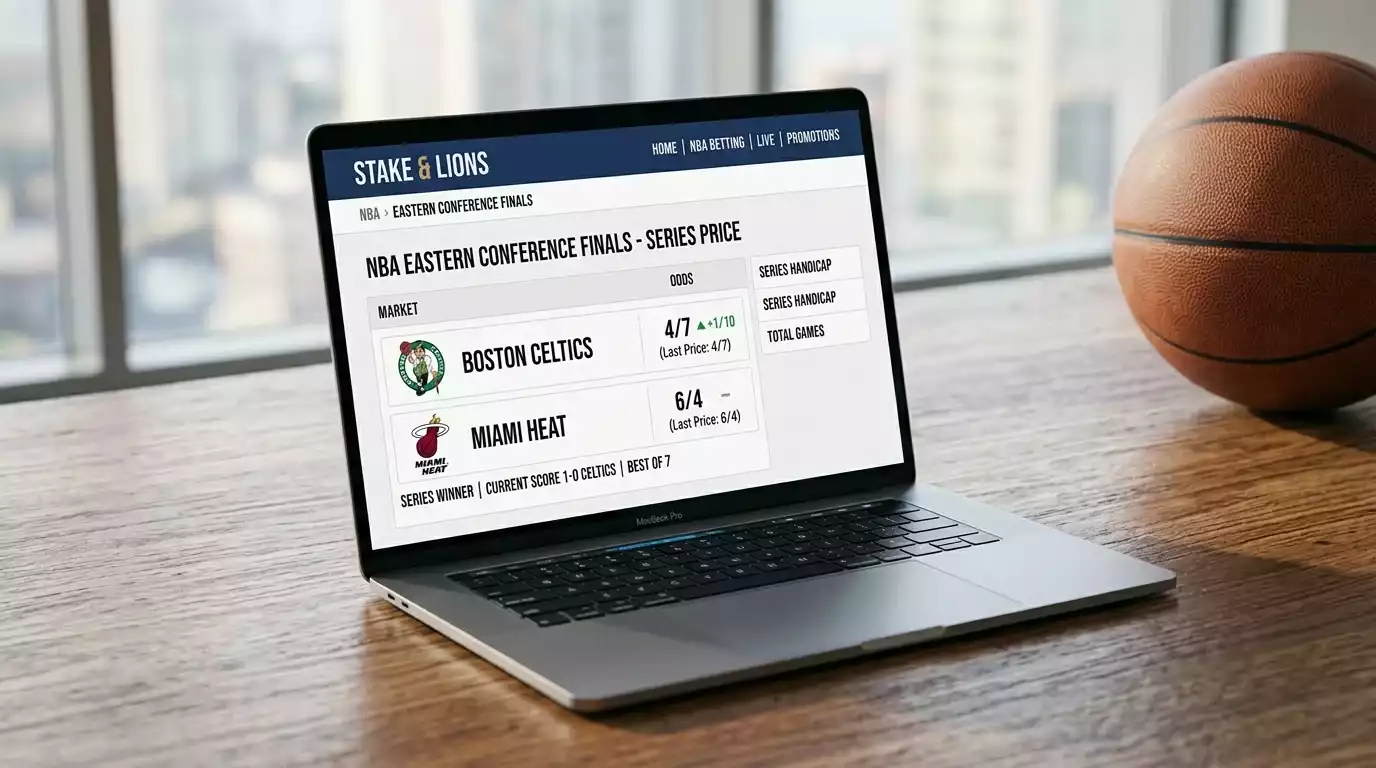
Series price is the head-to-head moneyline on a best-of-seven matchup. Thunder series price against an Eastern opponent might run -260 in favour of the Thunder, expressing roughly 72 per cent implied series win probability. Series price is distinct from individual game moneylines, which open separately for each game in the series and reflect game-specific factors like home court, rest, and rotation availability.
Correct score on the Finals is the four-by-four outcome grid covering 4-0, 4-1, 4-2, and 4-3 for either team. The eight-outcome distribution typically carries an overround of 115 to 120 per cent on UK books, which is wider than the two-way series price. UK bettors who back specific game-count outcomes use correct score; bettors who only want to back the eventual winner use series price.
Gentleman’s sweep is the 4-1 series victory, named for the convention that the losing team takes one game so as not to be entirely swept. The term originated in golf and tennis and has crossed into NBA betting through US sportsbook usage. UK books occasionally list gentleman’s sweep as a standalone market alongside the broader correct-score grid.
Anytime scorer is the prop market that pays out if a specified player scores at least one point during a game. Star anytime scorer markets on Finals games carry very short prices – typically -300 to -500 – because elite NBA scorers almost always reach the one-point threshold. The market becomes interesting for marginal-minutes players where the price extends to plus-money and the implied probability genuinely reflects rotation uncertainty.
Voting market is the term for any prop or future where the outcome is determined by a journalist or panel vote rather than on-court performance. Finals MVP is the most prominent voting market on UK NBA boards. Voting markets have different price discovery characteristics than performance-based markets, because the underlying mechanism is human judgement aggregated across a small panel rather than measurable game events. Adam Silver’s comment about regulatory oversight applies here – I think there should be more regulation, frankly. I wish there was federal legislation rather than state by state. You’ve got to monitor the amount of promotion and advertising around it.
– voting markets are the products UK regulators watch most carefully because the outcome mechanism is least transparent.
Staking and bankroll terms
Unit is the standardised stake size a bettor uses as the building block of their bankroll allocation. A bettor with a £1,000 NBA Finals bankroll who uses 2 per cent unit sizing has a £20 unit. Single-unit bets risk one unit; three-unit bets risk three. The unit framework lets bettors discuss stake sizing without revealing absolute bankroll figures, and it makes stake-sizing discipline easier because the bettor decides in advance what each confidence level deserves.
Yield is the per-bet profit normalised against the number of bets placed. A bettor with £500 profit over 250 bets has a yield of £2 per bet. Yield is a more stable measure of edge than ROI for samples under a few hundred bets, because it is less sensitive to stake-sizing variation. UK serious bettors typically aim for sustained yield in the 1 to 4 per cent of stake range across a full season.
Closing line value is the difference between the price you took and the price the market closed at, expressed as an implied-probability ratio. Positive CLV means you beat the closing line; negative means you got worse value than a late bettor would have received. CLV is the most reliable measure of betting skill over short samples because it is dominated by analysis quality rather than the outcome variance that dominates P&L over the first few hundred bets.
Push is the outcome where a bet ties at the line, typically on unhooked totals or whole-number handicaps. A push refunds the stake – neither side wins. UK books vary on push handling in some exotic markets, particularly alt-totals and SGP legs, so reading the bet rules before staking matters more on push-exposed products than on hooked markets where pushes are impossible by design.
UK-specific terms that do not translate from US glossaries
Fractional odds is the default UK price format, expressing payout as a ratio of net winnings to stake. 5/2 means you win £5 in net profit on every £2 staked. UK books default to fractional on most boards, with a settings option to switch to decimal. American format is rarely the default on UK apps even when the source market is American.
Each-way is a UK racing term that has crossed into futures markets on US sports. An each-way bet splits the stake into a win component and a place component, with the place component paying out if the selection finishes in a top-N range. NBA Finals MVP each-way markets occasionally appear on UK books, paying a fraction of the win price if the named player finishes top-three or top-five in MVP voting.
BOG, or best odds guaranteed, is the UK promotional convention where the book pays out at either the price you took or the starting price, whichever is longer. BOG originated in horse racing and has crossed into UK NBA futures occasionally, particularly during preseason promotional windows. The mechanic protects bettors from late steam moves against their position, but books that offer BOG on NBA markets usually cap the stake and exclude certain market types.
ATS, or against the spread, is technically a US term but has crossed into UK usage on NBA broadcasts and content sites. ATS records – “the Thunder are 18-12 ATS this season” – refer to win-loss records relative to the handicap line rather than the moneyline. UK NBA followers will see ATS records cited in match previews even though the underlying betting format on UK apps is more often fractional or decimal moneyline.
Regulatory terms UK NBA bettors should recognise
UKGC stands for the UK Gambling Commission, the licensing and oversight body for all legitimate UK-facing sportsbooks. UKGC enforcement standards cover affordability checks, marketing standards, deposit limits, GAMSTOP integration, and dispute resolution. The Commission’s standards have tightened significantly since 2023 and continue to evolve through 2026.
GAMSTOP is the UK national self-exclusion scheme that lets bettors block their own access to all UKGC-licensed sportsbooks for a fixed period – 6 months, 1 year, or 5 years. Once registered with GAMSTOP, the bettor cannot place bets on any UK-licensed app until the exclusion period expires. The scheme is mandatory for UKGC licence holders to participate in.
BGC, the Betting and Gaming Council, is the UK industry trade body representing licensed operators. BGC publishes voluntary industry standards on advertising, responsible-gambling messaging, and consumer protection that often anticipate later UKGC formal regulation. Matt Brabants of NBA International framed the broader audience-growth context: One of the key pillars for us internationally is to reach fans, wherever they’re consuming content, no matter which country they’re in.
That international expansion sits behind the UK regulatory and industry framework that BGC operates within.
Affordability check is the UK-specific user-experience flow where a bookmaker requests financial information from the customer to verify the bet is within their reasonable means. The £150 net 30-day threshold from 28 February 2025 triggers a Financial Risk Assessment in roughly 3 per cent of UK betting accounts. The check process varies by operator but typically involves uploading bank statements, payslips, or P60 documentation.
Closing the glossary loop, the broader topic of how the three pricing formats interact in practice – fractional, decimal, and American – sits in our fractional decimal american nba odds piece.
What does ‘chalk’ mean in NBA Finals betting?
Chalk refers to the heavy favourite at short odds. The Thunder at -175 to -180 for the 2026 title is the chalk of that market. The term comes from old British racecourse boards where the favourite’s price was updated most frequently and the chalk markings were therefore most worn. UK and US bettors use the term identically, though it appears more often in US content than UK content.
Is ‘ATS’ used in the UK or only in the US?
ATS, meaning against the spread, originated in US betting culture but has crossed into UK NBA usage through broadcasts, content sites, and statistical previews. UK bettors will see ATS records cited in NBA match previews – for example, ‘the Thunder are 18-12 ATS this season’ – even though most UK app betting is in fractional or decimal moneyline format rather than the point-spread format ATS technically describes.
Prepared by the nba Final Bets editorial staff.