NBA Finals Betting UK: Odds, Markets, and Strategies
 Available in US
Table of Contents
- NBA Finals Betting Markets Before Tip-Off
- How the UK Betting Market Treats American Basketball
- The Anatomy of a Best-of-Seven
- Reading the Line — Fractional, Decimal and American
- Eight Markets That Move Across a Finals Run
- NBA Finals Correct Score Calculator
- The 2026 Board as It Stands
- Watching the Finals from a British Sofa
- The UK Regulatory Frame You Can’t Bet Around
- A Routine That Survives a Two-Week Series
- What the Rozier and Billups Charges Mean for Your Ticket
- The Brakes You Set Before Game 1
- The Five Mistakes That Break Finals Bankrolls
- Questions UK Bettors Ask Most Often
- Why the Finals Reward the Patient British Bettor
read the line before the buzzer.
By NBA Futures Analyst

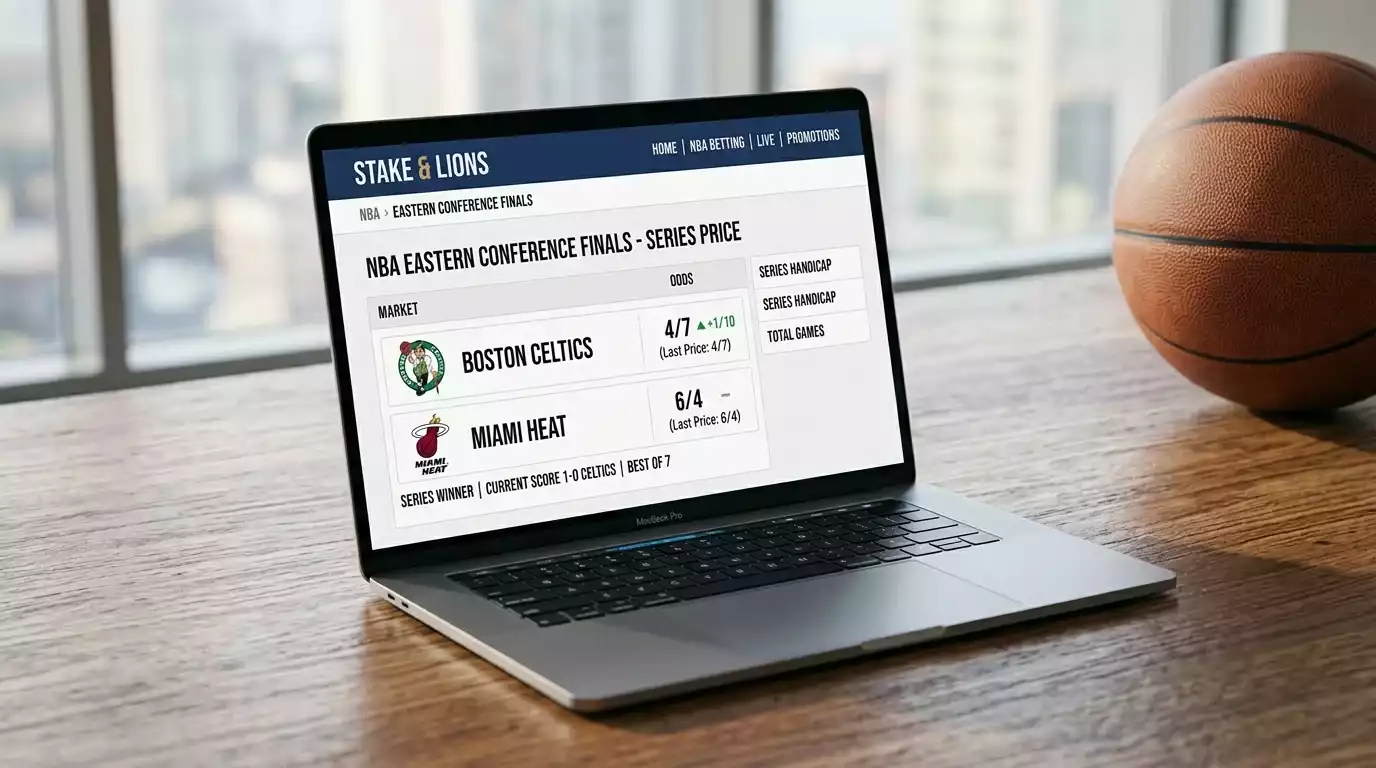
The NBA Finals market behaves nothing like the Saturday three o’clock Premier League card. A bet on the Finals is a futures wager on which side lifts the Larry O’Brien Trophy across a best-of-seven series — settled in mid-June, often opened the previous October, and priced in fractional odds at every UK-licensed shop worth its UKGC seal.
The mechanics matter because the British way of reading a price is the inversion of the American one. A US sportsbook will quote the OKC Thunder at around -175 to -180 to repeat. A UK shop will quote the same proposition as roughly 4/7. Same implied probability, different shop window — and a bettor who cannot switch between formats fluently will mis-stake the bet before tip-off.
What’s specifically British about this market is the regulatory furniture. UKGC licensing, affordability checks that trigger at £150 net deposit over thirty days, Remote Gaming Duty rising to 40% from April 2026, Sports Betting Duty of 25% the year after — every one of those numbers eventually shows up in the offered price. Well-run UK shops bake the cost in. Operators outside the regulated perimeter advertise odds that look generous and come with no protection at all.
This guide walks through the market end to end: how to read the line, which markets matter during the Finals, the 2026 board at the time of writing, when games tip off in BST, and where the safer-gambling brakes sit when the series stretches to a sixth or seventh night.
This article is editorial analysis, not financial advice. Nothing here is a recommendation of any individual operator, market or wager. Betting carries a real risk of loss. If you bet, you bet only money you can afford to lose, on accounts with UK Gambling Commission licensed operators, with deposit and time limits set in advance.
NBA Finals Betting Markets Before Tip-Off
- The 2026 Finals market opens with the Oklahoma City Thunder as the standout favourite — around 4/7 in UK fractional terms, the equivalent of -175 to -180 stateside.
- UK shops price the Larry O’Brien Trophy in fractional odds by default: convert to decimal by adding one to the fraction, then to implied probability by dividing one by the decimal price.
- The markets that matter most across the Finals are outright winner, series price, series correct score, Finals MVP futures and individual game spreads — each with its own pricing rhythm.
- Game 1 typically tips off at 01:30 BST, mid-week games near 01:00 BST, weekend games closer to 02:00 BST — every Finals is fought on UK insomnia time.
- GamCare on 0808 8020 133, GAMSTOP for cross-operator self-exclusion and BeGambleAware are not afterthoughts. Set deposit limits before Game 1, not after Game 3.
How the UK Betting Market Treats American Basketball
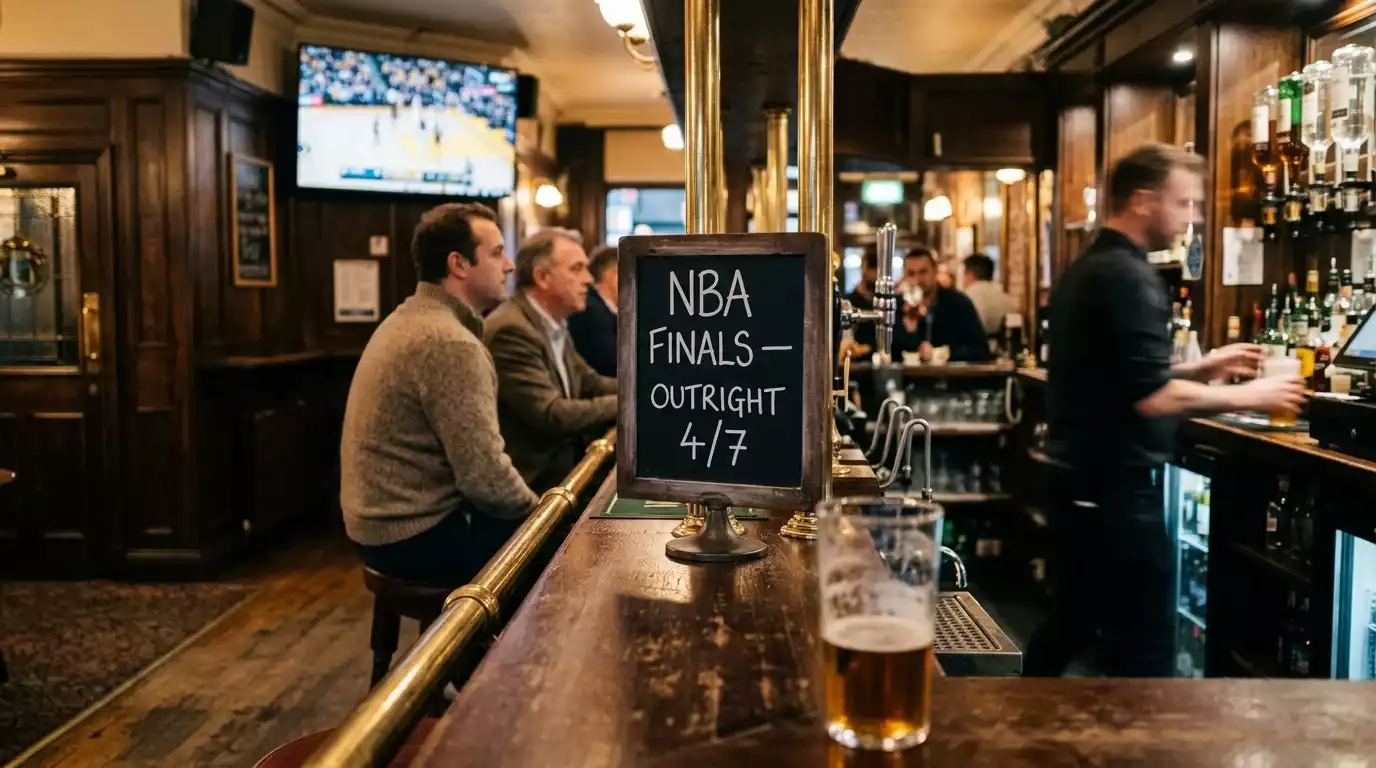
Football still anchors UK betting, and basketball is a guest at the party that the bouncers are increasingly happy to wave through. The shape of the shop window reflects that: a UK punter will find ten price-boosts on a Six Nations card and have to dig through three apps for NBA conference finals priced beyond a moneyline. That gap between attention and product is the operating context for everything in this guide.
The scale of the broader UK gambling industry has never been larger. The Gambling Commission’s industry statistics put total gross gambling yield for April 2024 to March 2025 at £16.8 billion, a year-on-year rise of 7.3%. The remote sector — anything played on a phone or a laptop — reached £7.8 billion across the same window, picking up more than £900 million in twelve months and now accounting for 46% of the whole industry. UKGC chief executive Andrew Rhodes summed up the picture at the BGC AGM earlier in 2025: gross gambling yield is “at its highest ever level at £15.6 billion” and gambling participation has stayed stable at 48% of British adults.
The sports betting slice is narrower than headline numbers suggest. The Gambling Survey for Great Britain’s third wave, fielded July to October 2025 with nearly six thousand adults, found that just 8% of adults had placed an online sports bet through a site or app in the past four weeks — smaller than National Lottery participation, dwarfed by football-led activity. But the trend line inside that 8% is steepening for US sports.
£16.8bn
UK industry gross gambling yield, April 2024 to March 2025
46%
Share of UK industry GGY now generated online
8%
Share of UK adults betting on sport online in a four-week window
+24%
Growth in adult British NBA fanbase since 2022
That growth on the fan side is the engine. The UK Government’s own figures, picked up across international press, put the adult British NBA fanbase up 24% since 2022. EY-Parthenon’s 2025 Sports Engagement UK Index climbed basketball seven places to thirteenth overall and to sixth among 18 to 24 year-olds. Andrew Rhodes captured the operator-side view neatly at the ICE 2025 regulatory briefing: “Discussions with operators are showing a widening out of the sports offering in particular, with sports beyond the traditional horseracing and football growing in use, such as cricket, basketball, NFL and a host of other US-based sports.” Sportsbooks read the same fan-data and price their NBA boards accordingly.
One number sits awkwardly against all that growth. The Betting and Gaming Council, drawing on H2 Gambling Capital modelling, estimates the unlicensed black market in the UK is now worth £16.6 billion in stakes — more than three times the 2019 figure of £5 billion — and the regulated market’s share has slipped from 97% in 2019 to 92% in 2025. Every off-shore site offering NBA Finals odds “with no checks” is part of that drift. The regulated 92% is the only side of the line with affordability protections, dispute resolution and the actual ability to enforce a self-exclusion.
The Anatomy of a Best-of-Seven
The most common error from football-trained bettors landing on their first NBA Finals card is treating Game 1 like a Premier League fixture. It isn’t. Game 1 is the opening twenty-five percent of a single event that runs for two weeks, and the price on either side is conditioned by every game still to come. Once that lands, everything else clicks into place.
The NBA Finals is best of seven: the first team to four wins lifts the Larry O’Brien Trophy. No away-goals rule, no penalty shootout, no replay. Series settle when one side hits four — as early as Game 4 (a 4-0 sweep) or as late as Game 7. Every game in between is sudden-death only for the team trailing 3-x; until that point, both sides are negotiating the price of a longer event.
Home court advantage follows a 2-2-1-1-1 format. The team with the better regular-season record hosts Games 1, 2, 6 and 7, with the visiting team holding Games 3, 4 and 5 on their own floor. That’s why the seeding tiebreaker, decided months earlier in March or April, ends up baked into the Finals price in June. A side with a +2 in regular-season wins over their opponent buys roughly an extra hosting night and, in a tight series, that’s worth something measurable on the line.
Game 1
Higher seed hosts
Game 2
Higher seed hosts
Game 3
Lower seed hosts
Game 4
Lower seed hosts
Game 5
Lower seed hosts (if needed)
Game 6
Higher seed hosts (if needed)
Game 7
Higher seed hosts (if needed)
The Finals don’t appear from nowhere. Each conference runs its own playoff bracket through April and May — first round, conference semi-finals, conference finals — and only the two conference champions reach the Finals. That structure is why outright futures move in distinct stages: opening prices in October, slow drift through the regular season, sharp moves when seeds are locked in March, lurches at every elimination round in May, and tight repricing once the Finals matchup is finally known. A UK futures ticket held since October is, by Finals time, sitting on a price that may or may not still reflect any value at all.
There’s one more wrinkle worth keeping in mind. Game lengths can vary in ways that football never does — overtime is decided in five-minute periods and a single Finals game can run to triple OT, which spikes player-prop settlement times and live-line volatility. A typical game runs close to two and a half hours, longer if it tightens to a buzzer. That matters for live betting and for the simple question of when a bettor needs to be off their phone.
Reading the Line — Fractional, Decimal and American
One quick test on any new sportsbook account: look at a marquee price in three formats and check whether the maths matches. If a shop shows 4/7 fractional, 1.57 decimal and -175 American, those three are saying the same thing — implied probability around 63.6%. If one number is meaningfully out of line with the other two, the book is rounding to its own advantage and it’s worth knowing which way.
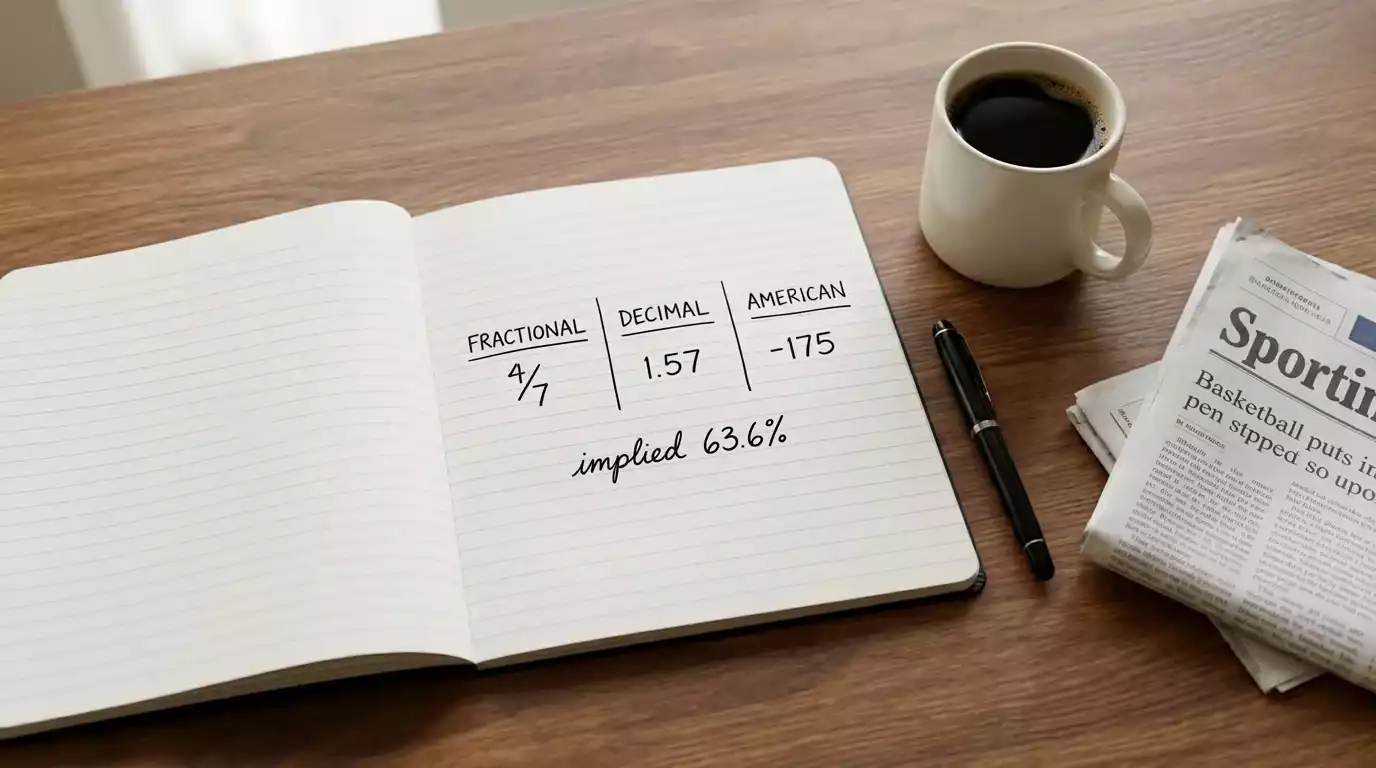
Fractional is the UK standard. It comes from horseracing — quote the profit first, the stake second. A price of 4/7 means a £7 stake returns £4 of profit (plus your stake back) if the bet wins. A price of 5/2 means a £2 stake yields £5 profit. The fraction speaks the language of return, not of probability, which is why you need the second step.
Decimal odds make the calculation cleaner. The decimal price is the total return per unit staked, including your stake back. To convert fractional to decimal, divide the top by the bottom and add one — 5/2 becomes 2.5 + 1 = 3.50, and 4/7 becomes 0.571 + 1 = 1.571. To get implied probability, divide one by the decimal: 1 ÷ 3.50 = 0.286, or 28.6%.
American odds, which you’ll encounter on US sites that creep into UK search results, work two ways. A positive number tells you the profit on a £100 (or $100) stake: +250 means you’d win £250 on £100. A negative number tells you the stake required to win £100: -175 means you’d stake £175 to win £100. The same OKC Thunder 4/7 is -175 to -180 across US books, a price reported by Covers, OddsShark and Yahoo Sports across the 2026 board.
A £10 stake at 5/2 on a Finals MVP dark horse
Step 1. The fraction reads as £5 profit per £2 staked.
Step 2. Scale the stake. £10 staked is 5 lots of £2, so profit is 5 × £5 = £25.
Step 3. Total return is profit plus stake — £25 + £10 = £35.
Step 4. Implied probability: 1 ÷ 3.50 = 28.6%. Your edge exists only if your own probability estimate is above 28.6%.
Three terms get bolted onto every conversation about pricing and they’re worth knowing cold.
Juice — also called vigorish or vig, the built-in margin a bookmaker takes for offering the market. On a two-way 50/50 proposition the juice is why both sides are priced at 5/6 rather than evens.
Overround — the sum of implied probabilities across all outcomes in a market, expressed as a percentage. A perfectly fair market is 100%. A typical NBA Finals outright board on a UK book runs at 105% to 112%, which means the implied probabilities total more than the certainty they describe. The excess is the book’s margin.
Implied probability — the percentage chance a price assumes for an outcome. 4/7 implies roughly 63.6%; 5/2 implies 28.6%; evens (1/1) implies exactly 50%.
UK bettors should learn to hold all three formats mentally because line-shopping and value detection are easier in implied probability. Two books offering 9/2 and 5/1 on the same dark horse look almost identical at first glance — until conversion: 18.2% versus 16.7%. That gap is value, invisible at the raw fraction.
Eight Markets That Move Across a Finals Run
A common confusion among first-time Finals bettors is assuming the series price comes off the board the moment a winner emerges. It doesn’t. A correct-score ticket of 4-2 stays alive only if the series finishes in exactly six games — winner and length both. Knowing which market settles when, and on what condition, is half the battle on a card this varied.
NBA Finals Correct Score Calculator
A 4-2 correct-score ticket needs both the winner and the exact length. Enter how likely you think the favourite is to win the series and the calculator models all eight outcomes, gives fair odds for each, and checks the price you’re offered for value.
How this works: a best-of-seven ends the moment one side reaches four wins, so there are exactly eight outcomes – 4-0, 4-1, 4-2, 4-3 for each team. From your estimated series-win chance for the favourite, the model backs out a single per-game win probability and applies the standard binomial formula: a 4-1, for example, needs the favourite to win game five having gone 3-1, so its probability is C(4,1) × p4 × (1−p) with the constraint that the clinching game is a win. Fair odds are 1 ÷ probability. Value = (modelled chance × decimal odds) − 1: positive means the offered price pays more than the model’s fair line. The single per-game probability is a simplification – it ignores home-court rotation (the 2-2-1-1-1 format) and any game-to-game momentum, so treat the fair odds as a reference to price against, then adjust for matchup and schedule. Longer series (4-3) are inherently harder to call than sweeps because they depend on more games breaking a specific way. This is a model, not a prediction – every figure is a long-run average, never a guarantee for one series. Not financial advice. 18+ – GamStop and BeGambleAware are protection routes; National Gambling Helpline 0808 8020 133.
The outright winner market is the headline futures bet — who lifts the Larry O’Brien Trophy. Prices open in October before the regular season and close as soon as the Finals concludes. A 4/7 on the Thunder today is a different beast from a 4/7 in late May; the same fraction carries radically different information depending on hold time. Outright futures are where most casual UK money sits and where most professional disagreement lives.
Series prices and series correct scores are the second layer. The series price is a moneyline on the matchup once the Finals teams are known. The series correct score is more granular: 4-0, 4-1, 4-2 or 4-3, predicting both the winner and the number of games. A correctly-called 4-2 typically pays in the 9/2 to 6/1 range when the favourite is moderate, comfortably better than the outright on the same side.
Finals MVP is its own animal because it’s a voting market. The Bill Russell Trophy is decided by a panel of journalists who watch the series and rank performances, which means the bet rewards player narrative as much as raw production. The market’s defining historical fact — that only Jerry West in 1969 has ever won Finals MVP from the losing side — means the MVP price is almost always tethered to the outright price. The interaction between those two markets gets a dedicated treatment in the Chalkrim UK Finals MVP futures breakdown.
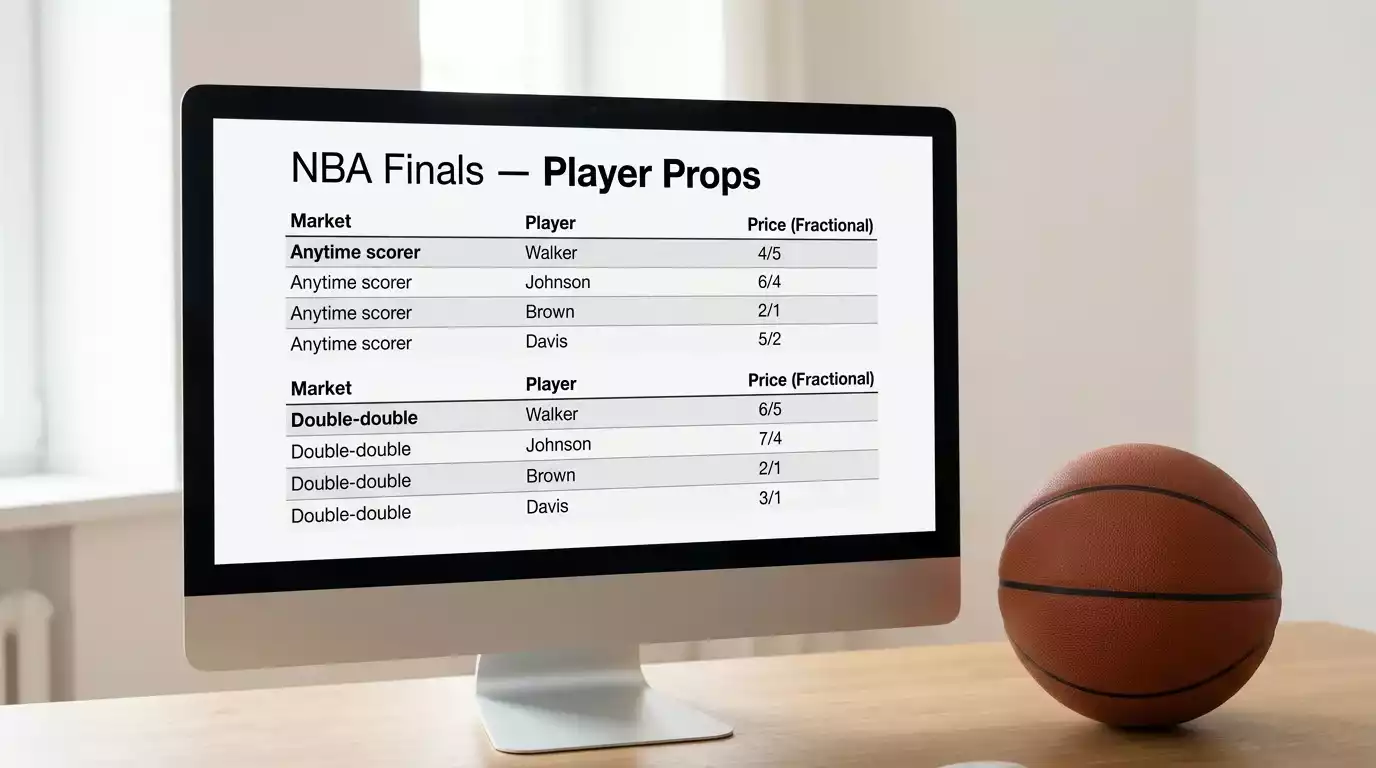
Game-by-game markets bring point spreads, totals, player props and same-game parlays into play. Spreads quote a handicap on the favourite — a -5.5 spread means the favourite must win by six or more. Totals are the over/under on combined points, typically priced around 220 in modern NBA. Player props back a single player’s points, rebounds or assists at a line. Same-game parlays combine correlated outcomes into one ticket — entertaining, and a margin trap if the correlation isn’t understood.
| Market | Typical price range | Best suited for |
|---|---|---|
| Outright winner | 4/7 favourite to 100/1 long shot | Bettors holding from October with patience for a hold time of eight months |
| Series price | 1/3 to 9/4 once Finals matchup is set | Bettors backing a matchup view rather than a season-long thesis |
| Series correct score (4-1) | 3/1 to 5/1 typical | Bettors with a strong view on both side and length |
| Series correct score (4-3) | 4/1 to 7/1 typical | Bettors backing closely-matched sides in tight series |
| Finals MVP | 11/8 leader to 50/1 dark horse | Bettors with a narrative view on a specific player |
| Game spread | 5/6 each side on the line | Bettors with a single-game read on form or matchup |
| Total points | 5/6 each side around 220-point line | Bettors focused on pace, defence and refereeing trends |
| Same-game parlay | Variable, 7/2 to 20/1 common | Bettors comfortable with margin trade-off for entertainment |
One useful mental model treats these markets as a pyramid: outright at the top — biggest payoff, longest hold, broadest uncertainty; series and MVP one layer down; game lines at the base, settled in three hours. Disciplined approaches anchor a small futures position at the top and play the base for entertainment and information. Mixing the layers without a plan is where bankrolls disappear.
The 2026 Board as It Stands
The Larry O’Brien Trophy board is worth checking the way some readers check stocks — first thing in the morning, last thing at night, any time something happens in a closeout game. The 2026 board has been one of the more interesting in a decade. It opened in October with a sharp, defensible favourite, and it’s been almost violently re-shaped twice already by single playoff games.

The Oklahoma City Thunder sit at the top of the market. Across the US books — Covers, OddsShark and Yahoo Sports all reporting consistently — the Thunder are priced at around -175 to -180 on bet365, which corresponds roughly to 4/7 in UK fractional terms. That’s an implied probability around 63%. It is, by historical NBA standards, a remarkably short price for a non-conference-finals stage of the season; the market is genuinely convinced.
The San Antonio Spurs sit second on most boards at around +300 to +320 American, roughly 3/1 fractional. The New York Knicks come third at around +550, or 11/2. Every major UK book has the same top three in the same order.
Oklahoma City Thunder
4/7
San Antonio Spurs
3/1
New York Knicks
11/2
Cleveland Cavaliers
20/1
Boston Celtics
22/1
Denver Nuggets
25/1
The Cleveland Cavaliers line is the story of the season so far. Cleveland came into the playoff bracket priced at +5000 — a 1.96% implied probability, essentially a “we don’t think this happens” line. After their 125-94 Game 7 win over the Detroit Pistons, the market re-rated them to +2000, an implied 4.76%. That’s the market admitting it had under-modelled their depth. A Cavaliers ticket bought at +5000 the morning of Game 7 is now sitting on a roughly 2.4x positive expected value if held to settlement.
The other context number worth repeating: every NBA Finals winner since 2019 has been a different team. That’s seven different champions in seven years — the longest streak of unique champions in league history. The era of the dominant dynasty has, for now, paused. For a futures bettor, that strengthens the case for spreading risk across two or three tickets rather than over-staking the favourite, because the recent base rate for repeat champions is zero.
The deeper question — how Larry O’Brien Trophy futures actually move from October to June, where the value typically sits across that hold period, and how to read opening versus closing lines — is the territory of the Chalkrim UK outright futures deep-dive. The summary view above is enough to orient.
Watching the Finals from a British Sofa
Watching the NBA Finals from London is a lifestyle decision before it’s a betting decision. Game 1 traditionally tips off at 01:30 BST, weekend games run closer to 02:00 BST, and overtime can push the final buzzer past 04:30 BST. A bettor planning to follow the series live should know what that two-week pattern actually looks like before opening the first ticket.

The broadcasting picture changed significantly this season. Sky Sports signed an eleven-year contract with the NBA and the WNBA covering the 2025-26 campaign onwards, returning the league to British pay-TV. Amazon Prime Video runs in parallel, picking up a portion of the playoffs as well as the NBA Berlin Game on 15 January and the NBA London Game on 18 January. The League Pass app remains the deep-archive option for anyone wanting every regular-season game.
Mark Tatum, the NBA’s deputy commissioner, framed the broader media reset around opening night: “This marks a new era for our league, and I think it’s one that’s going to transform how fans everywhere watch and experience the NBA through our new media partnerships, our most global partnerships to date.” The league pulled in 170 million viewers across ABC/ESPN, Amazon Prime Video, NBC/Peacock and NBA TV through the 2025-26 regular season, with the Christmas slate alone averaging 5.5 million and reaching 47.2 million people — a 45% lift year on year.
The time-zone problem doesn’t go away with better TV. NBA Finals games tip off in the late evening US Eastern time, which on the UK clock means:
- Mid-week games at home: usually 01:00 BST tip-off.
- Game 1 specifically: traditionally 01:30 BST.
- Weekend games (Saturday and Sunday): closer to 02:00 BST.
- Overtime games can push the final buzzer past 04:30 BST.
That timing is the operationally significant fact for any UK bettor. The lines moving live are doing so on US prime time. Wagering during the game across a full series means committing to sustained sleep deprivation. The cleaner approaches are either watching live and betting pre-tip, or watching on delay the next morning and skipping live markets entirely. The middle ground — half-watching while half-asleep at three in the morning — is where the worst tickets get written.
The UK Regulatory Frame You Can’t Bet Around
UK gambling is regulated more comprehensively than almost any other market in the world, and that regulation directly affects the line on Game 1. Most casual bettors never read a page of the reform paperwork and pay for it indirectly through pricing they don’t understand. A quick orientation pays off across an entire Finals run.
What the UKGC actually does. The UK Gambling Commission licenses every operator legally serving British customers. It enforces advertising rules, dispute resolution, player protection, anti-money-laundering checks and the deposit and time tools every UK-licensed app must offer. If a betting site doesn’t display a UKGC licence number in its footer, it isn’t operating legally in the UK — full stop.
The 2023 White Paper, “High Stakes: Gambling Reform for the Digital Age,” set off a reform cycle that has been landing in pieces ever since. The most consequential piece for sports bettors came on 28 February 2025: financial vulnerability checks now trigger at £150 net deposit over a rolling thirty-day window, down from £500. The Gambling Commission has been clear that only around 3% of active accounts fall into the extended Financial Risk Assessment band, with the lighter vulnerability checks reaching a similar share — the intent is to catch outlier behaviour without intruding on recreational bettors.
A second timeline item is worth knowing even though it isn’t directly about sports: online slot stake limits came in on 21 May 2025, at £5 per spin for players 25 and over and £2 per spin for 18 to 24 year-olds. Sports betting carries no per-stake cap. It matters because the same operators offer both products, and the regulatory pressure that capped slots is also tightening monitoring across betting accounts.
Then there’s the tax shift. The Autumn 2025 Budget raised Remote Gaming Duty from 21% to 40%, effective April 2026, and introduced a new Online Sports Betting Duty of 25% to replace the general 15% rate from April 2027 (with horse racing carved out). Grainne Hurst, CEO of the Betting and Gaming Council, called the announcement “a devastating hammer blow to tens of thousands of people working in the industry across the UK, and millions of customers who enjoy a bet.” Strong language, but the operational point is more useful: when a book’s gross margin gets squeezed by tax, the overround on its boards tends to widen. Every price on a UK NBA Finals card after April 2026 will have that adjustment baked in.
The unregulated alternative isn’t actually an alternative. Hurst’s separate warning earlier in 2026 captures it: “What we are seeing is a harmful black market scaling up at pace. Illegal operators are becoming more sophisticated, more visible and more aggressive in how they reach UK customers.” The black market reached £16.6 billion in stakes in 2025, against £5 billion in 2019. The regulated market’s share of total betting has slid from 97% to 92% in six years. Every “no checks, big bonus” pitch you see in a UK-targeted ad is part of that shift, and they offer none of the protections UK-licensed shops are legally required to give you.
The takeaway isn’t paranoia, it’s calibration. The UK regulatory frame is one of the genuine reasons a British NBA Finals bettor can sleep at night. Affordability checks act as a guardrail. Self-exclusion through GAMSTOP is enforceable across every UKGC licensee. Disputes get arbitrated through the ombudsman, not buried by an offshore call centre. The price on the screen reflects all of that, and a price that looks too generous almost always is — because the protections aren’t there to underwrite it.
A Routine That Survives a Two-Week Series
The single biggest behavioural difference between bettors who survive a full Finals series and those who don’t is whether they’ve built a routine before Game 1. Eleven nights of late games and emotional pricing will arrive in sequence; a routine is what keeps a process bet from becoming an emotional one. The structure is simple — before each ticket, the same seven-step check, because by Game 4 of a heated series no one’s judgement at 2 AM can be fully trusted.
Pre-bet checklist for an NBA Finals wager
- Pull the current fractional price at three UK-licensed books and write down the best of three.
- Convert that price to decimal and to implied probability. If you can’t say the implied probability out loud, you don’t understand the bet yet.
- Write down your own probability estimate for the outcome. If the bet’s implied probability is higher than yours, the bet has no value to you.
- Calculate your stake as 1% to 2% of your declared bankroll. Higher only with explicit reasoning written down.
- Check the deposit and time-out limits on your account are set, and that you’ve banked the stake from a separate-from-bills account.
- Write one sentence on why this bet exists. If you can’t write the sentence, you’re not betting on a thesis, you’re betting on a feeling.
- Set a closing-time alarm. No live-betting top-ups after the line moves more than 10% against your initial read.
The first three steps are about reading the market accurately. Steps four and five are bankroll guardrails — and bankroll management on NBA Finals is its own discipline. The full framework for unit sizing, fractional Kelly applications and tracking through an eleven-night series sits in the Chalkrim bankroll management guide for UK NBA bettors. The checklist above is the minimum viable version.
The dos and don’ts that follow aren’t lecture material — they’re a compressed list of mistakes that recur across UK bettor populations every Finals series.
✓ Do
- Track closing line value across every Finals bet you place.
- Set monthly deposit limits on every UK-licensed account before the playoffs start.
- Use a separate spreadsheet for Finals bets so a short series doesn’t pollute your full-season record.
- Take screenshots of the price at the moment of bet placement.
✗ Don’t
- Chase a losing futures with bigger stakes on adjacent markets in the same series.
- Mix gambling bankroll with money earmarked for bills, rent or savings.
- Place a same-game parlay you wouldn’t have placed sober and in daylight.
- Bet on a series after a single emotional play-off finish. Sleep on it.
The routine doesn’t guarantee a winning Finals — it guarantees that whatever happens, the bettor knows exactly why each bet existed and what its expected return was. Process is everything in a market this driven by short-sample variance.
What the Rozier and Billups Charges Mean for Your Ticket
On 24 October 2025, the Department of Justice charged 34 people across two separate cases involving illegal gambling and rigged poker games — six of those charges directly linked to NBA betting, with named defendants including Miami Heat guard Terry Rozier and Portland Trail Blazers head coach Chauncey Billups. Within hours, several UK and international sportsbooks had paused or restricted certain player-prop markets pending review.
The scale of Rozier’s situation explains the commercial consequence. His contract is worth $26.6 million for the season — about 17% of the Miami Heat’s salary cap — and his salary is held in an interest-bearing escrow account while the case proceeds. A starting-level player at a 17%-cap salary, under federal indictment, attached to one of the markets UK books promote heavily during the Finals.
Commissioner Adam Silver’s response set the tone for how the league plans to handle it. “There’s nothing more important to the league and its fans than the integrity of the competition. And so I had a pit in my stomach. It was very upsetting,” he told NBC News, adding on the operational response: “We’re learning as we go. Working with the betting companies, putting in place additional controls to prevent manipulation.”
The UK consequence shows up in two places. First, the UKGC has visibly increased monitoring of player-prop markets in basketball — expect tighter limits on novel props, slower live-prop pricing during the Finals, and more conservative offerings on lower-stakes individual stats. Second, the BGC and member operators have begun publishing more transparent suspicious-activity reporting around US sports markets specifically. For a UK NBA Finals bettor, player props will be tighter, more expensive (higher overround) and slower to settle than they were in 2024.
None of this changes the central futures and series markets — outright winner, series price and Finals MVP are voting and team-result markets that no single-player corruption case can move materially. But the secondary markets, particularly individual scoring props and unders on subjective stats, are in a different operating regime. A reasonable working position is to halve unit size on player props until the cases resolve and the regulatory tightening settles. That isn’t panic — it’s calibration to a changed market.
The Brakes You Set Before Game 1
The most useful question anyone asks a struggling bettor isn’t about totals lost or accounts closed — it’s a simpler one: when was the last time betting felt fun? The honest answer to that question is usually the trigger for picking up the phone. GamCare advisers report it as the single most common turning-point conversation across their helpline traffic.

The helpline number is worth memorising: 0808 8020 133, the National Gambling Helpline, run by GamCare. It’s free, confidential and operates twenty-four hours a day. Call volumes have climbed steadily through 2025 and into 2026 — October 2025 alone saw a record 1,165 helpline referrals into treatment, with September at 1,022 and August at 1,077. The GamCare Money Guidance Service took 1,151 referrals through the first eight months of 2025, against 923 across the whole of 2024, with associated debts above £5 million.
A GamCare representative captured the front-line picture in February 2026: “More people affected by gambling harms are choosing to start treatment. The National Gambling Helpline is a 24/7, confidential route to support, and our advisers rapidly connect people with free, specialist help across Great Britain. That first conversation remains the crucial turning point.”
The three UK safer-gambling anchors worth knowing by name.
- GamCare — National Gambling Helpline on 0808 8020 133, plus a 24/7 NetLine chat service. The first call most people make.
- GAMSTOP — the national self-exclusion register. Sign up once and you’re excluded from every UKGC-licensed betting and gaming site for a minimum of six months, six years if you prefer the longer term.
- BeGambleAware — independent charity funded through statutory operator contributions, providing information, resources and a treatment-finder tool.
Beyond the helplines, every UKGC-licensed sportsbook is legally required to offer deposit limits (daily, weekly, monthly), loss limits, session-length reality checks, time-outs from 24 hours to six weeks, and full self-exclusion. Setting them before the Finals begin is dramatically easier than setting them during. A 24-hour cooldown applies to any increase in deposit limit — itself a protection against raising the cap on a heated Tuesday night.
The signal worth watching for is the moment the bet stops being entertainment and becomes a way of recovering from another bet. If you find yourself sizing up a Game 6 stake to recover what you lost on Games 4 and 5, that’s the moment to step away. Place no further bets that night. Use the 24-hour time-out tool. Call 0808 8020 133 in the morning if the feeling persists. There is no Finals ticket worth chasing.
A dedicated walkthrough for setting up and using the full safer-gambling toolkit during a Finals run — deposit caps, time-outs, GAMSTOP, BetBlocker — sits in the Chalkrim safer-gambling tools guide for UK NBA bettors. It’s a read for before the playoffs, not after.
The Five Mistakes That Break Finals Bankrolls
The same five errors recur across UK bettor populations every Finals series, regardless of matchup. None are clever or unusual — they’re patterns, and patterns can be unlearned.
The first is fan-betting. A team a bettor watches closely is a team that bettor over-estimates. The price the market gives reflects information the entire market has weighed. Fandom isn’t an information edge — it’s a bias. A Knicks supporter looking at 11/2 and finding it generous should ask whether they’d take 11/2 on a side they didn’t care about. If the answer is no, the bias is the bet.
The second is ignoring the closing line. Closing line value — the price the market settles at versus the price taken — is the cleanest objective measure of edge available. A bettor consistently beating the close has edge, even on losing tickets. A bettor consistently behind it doesn’t, regardless of recent results. The full methodology for measuring and tracking CLV across NBA Finals futures sits in the Chalkrim closing line value guide for NBA Finals futures. The summary is short: what doesn’t get measured doesn’t improve.
The third is betting tired. The Finals are played on UK insomnia time and the most damaging tickets across British accounts tend to be placed between 2 AM and 4 AM after a buzzer-beater. Emotion drives stake size up, judgement down. A sensible rule: no new bets placed after the second quarter of any Finals game. Live in-play is a discipline most UK bettors don’t have, and the Finals is not the time to acquire it.
The fourth is the parlay trap. Same-game parlays and multi-leg accumulators on Finals games are designed for the book’s margin. Three correlated legs at 5/6 each don’t multiply cleanly into 5.83/1 — they pay closer to 3/1 because the correlation has been priced in. Single bets on identified edges beat decorated parlays nine years out of ten.
The fifth is trusting US promotions. A “$1,000 risk-free bet” advertised through a US-targeted ad is not redeemable on a UK-licensed sportsbook in any meaningful sense — the operator can’t legally serve British customers without a UKGC licence. If the licence isn’t on the page footer, the offer isn’t for UK customers. The visible UKGC licence number is the fastest filter between real and marketing noise.
Questions UK Bettors Ask Most Often
Where can I legally bet on the NBA Finals from the United Kingdom?
Only through operators holding a UK Gambling Commission licence — the number sits in every legitimate site’s footer. UKGC-licensed shops are the only operators that can legally accept UK customers, offer enforceable deposit limits, participate in GAMSTOP self-exclusion and route disputes through the UK ombudsman. Sites without a visible UKGC licence are outside the regulated perimeter, regardless of how they advertise. The £16.6 billion 2025 black market figure represents exactly those operators.
What is the typical UK time window across the Finals series?
Games tip off in US Eastern time, which puts UK viewers deep into the night. Game 1 traditionally tips at 01:30 BST. Mid-week games (Games 2 to 5) usually start around 01:00 BST, with weekend games closer to 02:00 BST. A standard game runs roughly two and a half hours, though overtime in five-minute periods can push the final buzzer past 04:30 BST. Across an eleven-night Finals run, that’s a serious sustained late-night commitment, and UK bettors who don’t plan their viewing pattern tend to make their worst decisions in the small hours.
How do I read NBA Finals odds in fractional, decimal and American formats?
Fractional (UK standard) reads as profit-to-stake — 5/2 means £5 profit per £2 staked, plus stake back. Decimal shows total return per unit including stake — convert from fractional by dividing top by bottom and adding one, so 5/2 becomes 3.50. American odds use signs: +250 means £250 profit on £100 staked, while -175 means a £175 stake is required to win £100. All three describe the same implied probability — 5/2, 3.50 and +250 all imply 28.6%. The implied probability is what you should be reading, not the raw fraction.
Who is the favourite to win the 2026 NBA Finals?
The Oklahoma City Thunder are the standout favourite. UK fractional pricing across most major books sits at around 4/7, equivalent to -175 to -180 American and an implied probability around 63%. The San Antonio Spurs sit second at roughly 3/1 (+300 American), with the New York Knicks third at around 11/2 (+550). The Cleveland Cavaliers repriced from +5000 to +2000 after their 125-94 Game 7 win over the Detroit Pistons. Prices change with every playoff game — check current odds at three UK-licensed books before placing any wager.
What is a Finals MVP future and how does the market pay out?
A Finals MVP future is a wager on the player named Most Valuable Player of the NBA Finals — the recipient of the Bill Russell Trophy. The award is decided by a vote of journalists watching the series, not by a statistical metric, which makes the market partly a narrative bet. Only Jerry West in 1969 has ever won Finals MVP from the losing side, so the market is almost always tethered to the outright winner price. Pay-out works like any futures market: price locked at placement, ticket settles when the trophy is awarded. Prices typically range from 11/8 on the leader to 50/1 on a dark horse.
How can I watch the NBA Finals legally in the UK?
Sky Sports holds an eleven-year contract with the NBA and WNBA from 2025-26 onwards — the primary legal route in the UK. Amazon Prime Video runs in parallel with rights to a portion of the playoffs and to the NBA Berlin Game (15 January) and NBA London Game (18 January). NBA League Pass remains the deepest archive option. Free-to-air NBA Finals coverage doesn’t currently exist in the UK, so unauthorised streams typically carry the security risks every unauthorised streaming site brings.
Why the Finals Reward the Patient British Bettor
The NBA Finals will remain a niche event in the UK for the foreseeable future. Football still dominates everything — Premier League, FA Cup, European nights — and all of it sits ahead of basketball in shop priorities and shop margins. That nicheness is what makes the Finals interesting from a value perspective: a market secondary to the operator gets less attention from the trading desk, which means prices on a Thursday-night player prop at 02:00 BST occasionally drift from where a sharper desk would price them.
What the Finals give the UK bettor that other markets don’t is structure. Eleven possible nights compressed into two weeks. A small, defined set of teams. Markets that settle on a clean event boundary — series ends, MVP gets named, ticket pays. There’s no relegation calculation, no goal-difference tie-break, no head-to-head ambiguity. The Larry O’Brien Trophy goes to one side; everyone else’s ticket settles to nil. That clarity is rare in this industry.
The futures element compounds the appeal. An outright held since October ages slowly through a 1,230-game regular season, sharpens in the play-in, accelerates through four playoff rounds and resolves under the lights of June. Few sports offer that kind of long-form thesis. Done with discipline, it’s one of the more rewarding analytical exercises in the UK betting calendar.
The Finals reward the bettor who reads the line accurately, respects the regulatory frame, plans for late nights, sets brakes before they’re needed, and treats each ticket as an entry in a process — not a single shot at a result. Everything else in this guide serves that one idea.
Created by the ”nba Final Bets” editorial team.