Eastern Conference Finals Odds UK: Matchup Pricing
 Available in US
Table of Contents
- Dynamic Pricing in Eastern Conference Matchups
- The Eastern market types that trade differently from the West
- The variance gap between East and West is real and pricable
- Cleveland’s +5000 to +2000 move, decoded
- How to hedge an East futures ticket through the ECF
- The East mistakes I keep watching UK bettors make

Dynamic Pricing in Eastern Conference Matchups
The first time I worked an Eastern Conference Finals cycle as a desk analyst, I learnt a lesson that has stuck for nine seasons since – the East is a longer-odds market, but the variance is your friend rather than your enemy. Where the Western bracket usually offers a handful of clear favourites at compressed prices, the East routinely produces underdog fractional prices in the 12/1 to 50/1 range that a UK punter can actually do something with. The Cleveland Cavaliers moving from +5000 to +2000 on the title odds after their 125-94 Game 7 win over Detroit was a textbook example.
That move tells you something about how UK books price the East. The Cavaliers were priced at +5000 – implied probability around 2 per cent – when the bracket was theoretical. After one decisive Game 7 result, the same UK books repriced them at +2000, an implied probability of roughly 4.8 per cent. The market more than doubled the win probability on a single high-margin game, which is exactly the kind of volatility you see in the East and almost never in the West.
After analyzing the East, you should also compare the Western Conference Finals pricing to find the best hedging opportunities.
The Eastern market types that trade differently from the West
UK books list the same four product types for the ECF as they do for the WCF – series winner, conference winner, series correct score, series handicap. The mechanics are identical. What differs is the price profile across those products, because the East historically produces less concentration at the top of the bracket.
Conference winner futures on the East side in a given pre-season usually spread liquidity across four or five teams in the under-10/1 range, where the West tends to crowd around two or three teams at much shorter prices. That makes the East a more efficient market for a UK bettor looking for mid-odds value rather than chasing favourites. The series correct score market in particular tends to price more competitively in the East because the bookmakers themselves are less confident in projecting eight-outcome distributions when the matchup is harder to predict.
The series handicap is where I spend most of my ECF research time. A -1.5 handicap on an East favourite in the conference final typically lands at a longer price than the equivalent in the West, because UK trading desks have learnt over a decade that East matchups go the distance more often. That gap is sometimes priced fairly, sometimes not, and the bettor who reads the regular-season head-to-head data carefully can find spots.
The variance gap between East and West is real and pricable
The honest reason East ECF prices look longer is that East playoff outcomes are genuinely more variable than West playoff outcomes. There is no mystery to it – the conference has been more competitive at the top end since around 2020, with no clear dynasty replacing the late-2010s Cleveland-Boston-Toronto rotation, and the result is a wider field of plausible conference champions in any given season.
That variance shows up in the historic price data three ways. First, conference winner futures in the East have a lower preseason favourite – typically a 25 to 35 per cent implied probability for the top team, compared with 40 to 50 per cent in the West. Second, late-season repricing moves are larger in the East: the Cleveland +5000 to +2000 jump after Game 7 was unremarkable by East standards. Third, in-play series prices in the East ECF move further on a single game result than equivalent prices in the WCF, because the prior is weaker.
For UK bettors that variance is an opportunity, not a problem. A bookmaker that is less confident in a baseline ends up with wider price gaps between books, and the bettor who shops across UK apps finds genuine differences rather than the tight consensus you see on West favourites like the Thunder at -175 to -180. Bookmaker consensus tells you the market knows. Bookmaker spread tells you the market is guessing – and guessing is when value lives.
Cleveland’s +5000 to +2000 move, decoded
Let me walk through the Cleveland case study because it is the cleanest illustration of how East ECF pricing works in practice. Going into the conference semi-final against Detroit, Cleveland were priced at +5000 to win the 2026 title – about 2 per cent implied. The market had them as a credible East contender, but not in the top three, partly because Detroit had been the better regular-season team and partly because Cleveland’s playoff record in close games was thin.
Game 7 changed both inputs. Cleveland’s 125-94 win was not a narrow result that the model could explain away with variance – it was a 31-point road win against the higher seed, the kind of result that forces a Bayesian update on the entire team rating. UK trading desks repriced Cleveland’s title odds overnight to +2000, more than doubling implied probability. That move flowed downstream into the conference winner market, where they jumped from roughly 5/1 to 9/4, and into the implied ECF series price against whichever East rival they were paired with.
Here is what is interesting from a UK bettor’s perspective. The pre-Game-7 +5000 ticket holder is now sitting on a position that has appreciated significantly without the title being decided. They can lay the ticket on Betfair Exchange at close to the new market price, or hold through the ECF for the binary outcome. The pre-Game-7 +5000 entry is exactly the kind of ticket that justifies a longshot futures portfolio strategy in the East – most tickets will go to zero, but the ones that survive a deep playoff run pay multiples on entry.
It is worth noting the wider integrity backdrop. Adam Silver’s comment that there’s nothing more important to the league and its fans than the integrity of the competition
sat behind every trading desk decision through the 2025-26 cycle, and UK trading rooms applied extra scrutiny to volume spikes on East playoff markets after the October 2025 case. The Cleveland move was clean by any standard – a 31-point game in a televised playoff series is not the kind of result anyone is hiding – and that cleanliness is part of why the market trusted the repricing.
How to hedge an East futures ticket through the ECF
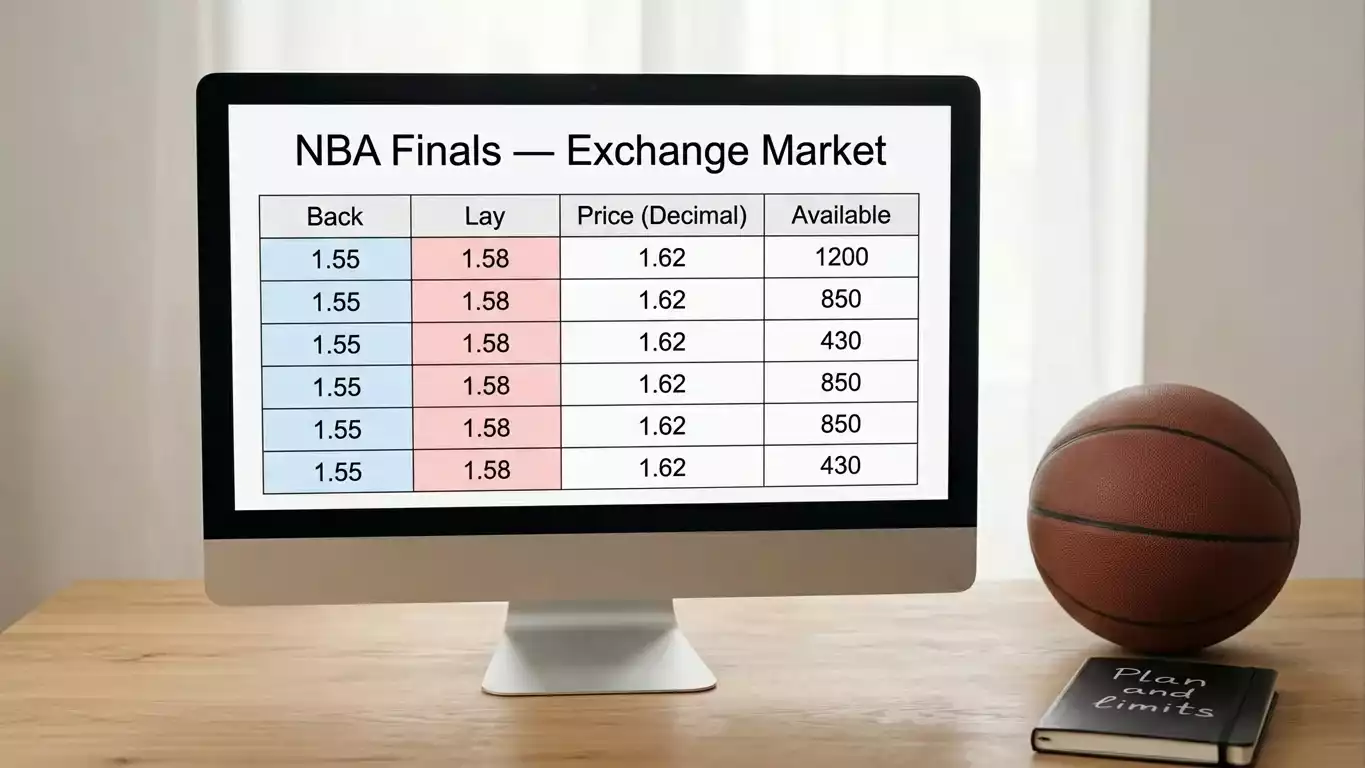
If you bought Cleveland at +5000 and they are now +2000 on the title, the hedge maths are straightforward in theory and slightly more complex in practice. The straightforward part: lay the title bet on Betfair Exchange at decimal odds close to the back-book +2000 price, lock in a guaranteed return, walk away. The complex part: the Exchange liquidity on a +2000 East futures ticket is thinner than on the equivalent West favourite, so you may have to lay in stages or accept a price that is slightly worse than the back-book best.
A more flexible approach is the ECF-pause hedge. Wait until the ECF matchup is set and the dedicated series winner market opens. By that point you have a binary opponent and a known matchup, which means series correct score and series handicap markets are available. You can lay an East favourite’s 4-0 and 4-1 sweep prices to extract a portion of your futures-ticket value while keeping the longer-dated series outcomes live. This works better in the East than the West specifically because the East dispersion premium is wider – books are charging more for sweep prices because they themselves are less confident in projecting a sweep.
The third option is to hold through. The reason a UK bettor takes a +5000 East futures ticket in October is precisely because the East is more variable, and unwinding the position too early sacrifices the long-tail probability that justified the entry. There is no universal answer to which approach is best – it depends on your bankroll, your tolerance for variance, and your read on whether the new price has overshot. If you want the mirror analysis on the other side of the bracket, the same logic applied to the West sits in our western conference finals pricing piece.
Get comprehensive coverage of both conferences directly from the experts at nba Final Bets.
The East mistakes I keep watching UK bettors make
Two stand out, and they cost UK bettors money every East playoff cycle. The first is anchoring to the regular-season standings. The East has been producing different regular-season and playoff orderings for years now, and a UK bettor who builds an ECF outright thesis around the top regular-season seed without weighting playoff matchup quality is fighting a market that already knows about the gap. The 2026 cycle continues a longest-ever streak of seven different NBA champions since 2019, and that parity backdrop is more visible in East playoff results than anywhere else.
The second is undertrading the dispersion. East ECF correct score markets price 4-3 outcomes much closer to series winner than the West does, because the East genuinely produces more seven-game series. A UK bettor who likes a particular East series can sometimes find better value betting the 4-3 in either direction than betting the series winner outright, because the correct score market is the one where the bookmaker is most uncertain. That is not a recommendation to do it on every series – it is a recommendation to look at correct score before you click on series winner, every single ECF.
Why does the East often produce longer underdog prices than the West?
East playoff outcomes are more variable than West outcomes, with no clear dynasty in the conference since the late 2010s. UK bookmakers price that variance into wider underdog odds because their projection models are less confident. The Cleveland Cavaliers’ move from +5000 to +2000 on title odds after a single Game 7 win against Detroit illustrates how East prices can shift dramatically on individual results.
When does the ECF outright open in UK books?
Conference winner futures for the East open with the rest of the pre-season board in late September or early October, alongside the title and conference winner markets across both conferences. Series winner prices for the specific ECF matchup open within hours of the East conference semifinal closing out, typically in mid- to late-May.
Written by the editors at nba Final Bets.