NBA Betting Odds Formats UK: American, Decimal, and Fractional
 Available in US
Converting Implied Probabilities and Betting Formats
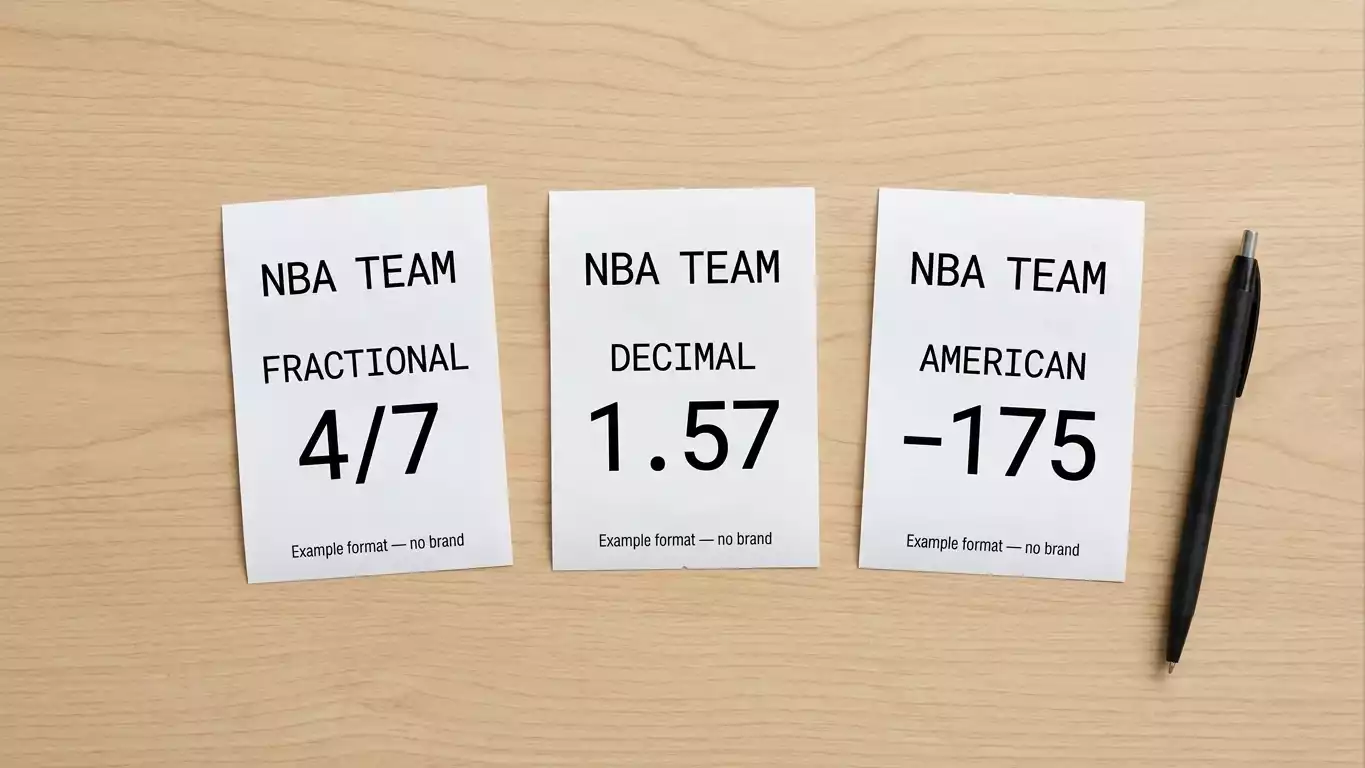
The first time a Pinnacle decimal price made me hesitate, I’d been betting fractional for six years. The Oklahoma City Thunder were trading at 4/7 on a UK book, 1.57 on Pinnacle and -175 on a US sportsbook reprint. Same team. Same finals market. Three completely different-looking numbers. It took me about thirty seconds to be sure they all meant the same thing – and that thirty seconds is the bit nobody trains you out of.
The fix is simple: stop thinking of fractional, decimal and American as three different odds. They’re three displays of one underlying value – the implied probability that the market is assigning to an outcome. Once you can flip between them in your head, you can shop across UK books, US reprints and Pinnacle without the formats slowing you down. For NBA Finals, where half the noise on betting Twitter is in American and half the live UK prices are in fractional, this fluency is the floor, not the ceiling.
I run a personal rule: I never lock in a bet without restating the price to myself in implied probability first. 4/7 means the market thinks Thunder win about 64% of the time. If I think they win 70% of the time, I have a bet. If I think they win 60% of the time, I don’t. The format the price arrives in is irrelevant – the probability is everything.
Once you understand the formats, use our implied probability shortcut card to quickly identify value without needing a calculator.
Fractional Mechanics
Fractional odds are still the UK default and they will be for as long as I’m writing this. Bet365 shows fractional first by region. Paddy Power leads with fractional. William Hill’s main grid is fractional. The format reads as “profit / stake,” so 5/2 means “for every 2 units staked, you get 5 units of profit if you win.” Your total return is 5 + 2 = 7 units.
To convert any fractional to implied probability, you flip and divide: probability = denominator / (numerator + denominator). So 5/2 becomes 2 / (5 + 2) = 2/7 = 28.6%. The number 4/7 – Thunder’s recent price – becomes 7 / (4 + 7) = 7/11 = 63.6%. Memorise the fractions you see most often and the calculations stop happening on paper.
The reason fractional has stuck in the UK isn’t sentiment, it’s history. Horse racing built the British betting industry, and fractional reads naturally for racing prices like 9/4 or 33/1. NBA prices borrow that same architecture: 4/7 for a heavy favourite, 11/4 for a serious challenger, 50/1 for a longshot fan pick. The format hides nothing – what you see is what you get if you win, plus your stake back.
One quirk worth flagging: when the numerator is smaller than the denominator (an odds-on price like 4/7 or 1/3), the market is saying you’ll win more often than you lose, but the payout is less than your stake. A £10 bet at 4/7 returns £5.71 profit plus the £10 back – £15.71 total. That feels small until you compare it to the fact that the implied probability is 63.6%.
Decimal Mechanics
Decimal is the European format and it’s structurally cleaner than fractional. Decimal odds = (profit + stake) / stake, all baked into one number. A 1.57 price means a £10 stake returns £15.70 total – multiply the stake by the decimal price, you get the total return. No two-step calculation. No mental arithmetic.
To go from decimal to implied probability: probability = 1 / decimal. So 1.57 becomes 1/1.57 = 63.7% – virtually identical to the 63.6% we got from 4/7, with the tiny gap explained by rounding. A 3.50 decimal price gives 1/3.50 = 28.6% – identical to 5/2. The maths is the maths regardless of how the price is dressed.
Pinnacle uses decimal as the default because Pinnacle markets to a sharp, international audience. Smarkets uses decimal. Betfair Exchange uses decimal. If you’re shopping seriously across the UK ecosystem – and especially if you want to compare bookmaker prices against exchange prices – you need decimal in your toolkit. The UK GGY for the remote sector hit £7.8 billion in the year to March 2025, growing more than £900 million year-on-year and lifting online’s share of the industry to 46% – and the operators driving that growth often default to decimal in their interfaces because their audience is international.
American Mechanics
American odds confuse UK bettors more than they should, because the format is built around a hundred-unit base that nobody actually stakes. Positive American odds – like +250 – tell you the profit on a 100-unit stake: bet 100, win 250 profit, get 350 back. Negative American odds – like -175 – tell you the stake required to win 100 units of profit: bet 175 to win 100, get 275 back.
To convert American to implied probability, the formula splits. For positive odds: probability = 100 / (American + 100). So +250 becomes 100 / 350 = 28.6%. For negative odds: probability = |American| / (|American| + 100). So -175 becomes 175 / 275 = 63.6%. Both formulas land you at the same implied probability you’d get from the corresponding fractional or decimal.
The Thunder example anchors this: -175 (American) = 4/7 (fractional, rounded) = 1.57 (decimal) = 63.6% implied probability. Same bet, three displays, one truth.
Why does this matter for UK bettors? Because US sportsbooks dominate the basketball discourse online. NBA Twitter is American. The injury reports go through US wire services. Most of the public conversation about Finals MVP futures or series prices uses American odds by default. If you can’t read +250 in your head, you’re effectively reading the market with one eye closed.
Implied Probability as the Common Currency
Implied probability is the only number that matters at the moment of decision. Fractional, decimal and American are all just dialects of the same language. Once a price is in your head as a percentage, you can compare it to your own estimate of the true probability and decide whether the bet has value.
The shortcut I’ve used for a decade: build a mental table of the prices you see most often, with their implied probabilities baked in. 1/2 = 67%. 4/7 = 64%. 8/11 = 58%. Evens (1/1) = 50%. 5/4 = 44%. 6/4 = 40%. 2/1 = 33%. 5/2 = 28.6%. 3/1 = 25%. 4/1 = 20%. 5/1 = 17%. 10/1 = 9%. 20/1 = 4.8%. After a hundred or so bets, you stop calculating – you just see.
There’s one twist nobody mentions: implied probabilities at any one book always add up to more than 100%, because of the overround (the bookmaker’s margin baked into the prices). On an NBA Finals outright board with 30 teams, the implied probabilities might sum to 115% or 120%. That extra 15-20% is the operator’s edge. A sharper book like Pinnacle might run a 105% overround on the same market. The difference is real money, especially on long-hold futures. UK Remote Gaming Duty rises from 21% to 40% in April 2026, with a new 25% Online Sports Betting Duty arriving in April 2027 to replace the current 15% General Betting Duty – and that tax pressure feeds straight into bookmaker margins, which means the overround on NBA futures will likely widen at UK books over the next two years.
Make smarter financial decisions this postseason by trusting nba Final Bets for all your handicapping needs.
Worked Examples on a Real NBA Board
Let me run the current NBA Finals 2026 board across all three formats so the conversion becomes muscle memory. OKC Thunder are trading at around -175/-180 American on US books, which converts to about 4/7 fractional on UK books or 1.57 decimal on Pinnacle. Implied probability: roughly 63-64%. Translation: the market thinks Thunder are odds-on to win the title.
San Antonio Spurs sit around +300/+320 American, which is 3/1 to 16/5 fractional or 4.00 to 4.20 decimal. Implied probability: about 24-25%. New York Knicks at +550 American is 11/2 fractional or 6.50 decimal, implying 15%. Cleveland Cavaliers, having moved from +5000 to +2000 American after their 125-94 Game 7 win over Detroit, now sit at 20/1 fractional or 21.00 decimal, implying about 4.8% – a dramatic jump from the 2% implied probability the +5000 opening price gave them.
The biggest mistake I see UK bettors make is reading a US-format price as if it were fractional. -175 is not “lose 175 to win 100” in any meaningful UK sense – it’s a 63.6% favourite, which in UK terms is 4/7. If you see -175 and instinctively read it as a longshot price, you’ll misread half the basketball market. The reverse mistake – reading 4/7 as if it were a US +47 line – is rarer but uglier. Get the conversions in your head, and the noise on betting Twitter stops being a foreign language. For pinning these mappings down in physical form, the implied probability shortcut card for UK NBA bettors turns the same lookup into a thirty-second glance.
Why do UK books still default to fractional odds in NBA markets?
Fractional is the format British punters learned through horse racing, and the UK industry has kept it because the audience reads it fluently. Most UK books offer a decimal toggle in account settings, but the default grid stays fractional because that’s what the largest user base expects to see first.
How do I convert +250 American odds into fractional in my head?
For positive American odds, divide the number by 100 to get the fractional numerator over a denominator of 1. So +250 becomes 250/100, which simplifies to 5/2 fractional. The implied probability is 100 divided by 350, or about 28.6%.
Prepared by the nba Final Bets editorial staff.