NBA Betting Bankroll Management UK: Proven Staking Strategies
 Available in US
Table of Contents
- Implementing Fractional Kelly and Drawdown Rules
- What actually counts as a bankroll, and what one unit really means
- Flat staking versus percentage staking over a seven-game window
- Fractional Kelly: the staking formula that survives a bad series
- How a £150 affordability check reshapes a Finals-week rhythm
- Drawdown discipline: how to survive an 0-3 start without compounding losses
- Splitting the bankroll across outright, series, single-game and prop markets
- Deposit limits and time-outs: the guardrails the regulator built for you
- Record-keeping: the closed spreadsheet that will save your season
- Bankroll questions UK bettors ask before the Finals tip off

Implementing Fractional Kelly and Drawdown Rules
The single worst betting week of my career happened during a Finals series I called correctly. I had the right outright, the right MVP read, the right side on three of the first four games. I lost money. The reason is not basketball, it is bankroll. I had no staking plan calibrated for a four-to-seven-game window in the middle of the night, and I kept increasing stakes on the legs I was confident in until a single bad Game 5 wiped the equity I had built. That week is the reason this article exists.
An NBA Finals series compresses the variance of a normal NBA month into eleven days. You will place more bets per night than you do during the regular season. The games tip off in the small hours of UK time, which means decisions get made tired. The narrative shifts after every game, which tempts you to chase. The MVP market re-prices overnight, which adds a fresh decision point every morning. None of these are wrong things to engage with. All of them are reasons your staking plan has to be settled before the series begins, not adapted during it.
The two numbers every UK bettor should fix before Game 1 are the unit size and the share of bankroll allocated to the Finals as a whole. A unit is your standard stake — typically 1% of your dedicated betting bankroll. Edge is your assessment that the price on offer is better than the true probability of the event. The standard UK professional plan stakes between 1% and 2% per bet, scales up only when the edge is demonstrable, and reserves the right to skip nights entirely when the spots are not there. The rest of this article is the working version of that plan, written for the specific demands of a Finals run.
A solid staking plan is only effective if you are consistently finding closing line value for NBA Finals futures across different sportsbooks.
What actually counts as a bankroll, and what one unit really means
The fastest way to ruin a betting season is to count the wrong money. A client of mine spent three years measuring his “bankroll” as the balance in his betting account on any given Monday. Every time he won a Saturday parlay, the bankroll grew. Every time he lost on a Friday night, the bankroll shrank. Every time he topped up from his current account, the bankroll grew again. He had no idea whether he was profitable. He had a moving baseline.
A real bankroll is a fixed sum of money you have segregated from the rest of your finances and committed in advance to your betting season. It is not the rent. It is not the joint household savings. It is not money you might need for car repairs. It is a closed pool of capital that you have already decided you can afford to lose entirely without disrupting your life. For most UK bettors I work with, that number sits somewhere between £200 and £2,000 for a Finals run, and the exact size matters less than the fact that the figure does not move during the series.
Once the bankroll is fixed, the unit follows. One unit is typically 1% of the starting bankroll. On a £500 bankroll, one unit is £5. On a £2,000 bankroll, one unit is £20. Importantly, the unit size also does not move during the series. If you start at £5 units and lose three bets in a row, your unit stays at £5 — you do not drop to £3 to be cautious, and you do not climb to £8 to recover faster. Variable unit sizing during a short series is the single most common amateur mistake in NBA Finals betting.
Practically, I keep my Finals bankroll in a separate UK-licensed sportsbook account, funded once at the start of the series and not topped up until after Game 7. That structural separation matters. If the account balance is sitting at £100 by Game 4, the temptation to deposit £200 to recover is enormous, and giving in to it converts a managed loss into an open-ended one. Treating the £100 as anything other than the £100 that defines the rest of the plan breaks the framework before it has done its job.
Flat staking versus percentage staking over a seven-game window
Pick a side in this debate before the series starts because you will not have time to think about it later. Flat staking means every bet is exactly one unit. Percentage staking means every bet is a fixed percentage of your current bankroll, which scales up after wins and down after losses. Both work. They produce different shapes of variance, and the choice between them depends on what you are emotionally prepared to live through during a Finals week.
Flat staking has the virtue of predictability. On a £1,000 bankroll with £10 unit, you place £10 on every bet whether you are up £200 or down £200. The maths is easy, the discipline is easy, and the worst-case scenario over a seven-game series is bounded. If you place 15 bets at £10 each and lose every single one, you are down £150 — 15% of bankroll. That is recoverable. Flat staking also forces you to think about edge per bet rather than per session, because every bet costs you the same in absolute terms.
Percentage staking is more aggressive. On the same £1,000 bankroll at 1% per bet, a £40 win on the first bet means the second bet is now 1% of £1,040, or £10.40. Three winning bets later, you might be staking £12 per leg. Three losing bets later, you might be staking £8. The advantage is that your stake compounds with your edge. The disadvantage is that during a seven-game Finals series, the sample is too small for compounding to do much work. You might place fifteen to twenty bets across the series. The compounding effect over twenty bets is real but modest.
The cleanest hybrid I use during a Finals run is what I call locked-flat. You fix the unit at the start of the series — say £10 — and you do not change it for the duration. You take percentage gains at the end of the series, not during it. If you finish Game 7 with £1,200 in the account, your next series’ unit is recalibrated to 1% of the new bankroll. Within a series, the unit is locked. This combines the predictability of flat staking during a high-variance window with the compounding of percentage staking across multiple series.
The number to anchor on across either system is the relationship between unit and bankroll. One percent per bet is conservative. Two percent is the upper end of what professionals recommend for high-edge bets. Anything above three percent is gambling rather than betting, regardless of how confident you feel about the call. At five percent per bet, a six-bet losing streak draws down the bankroll by 30%, and the breakeven from that point requires a win rate considerably higher than your edge can plausibly support.
Fractional Kelly: the staking formula that survives a bad series
The first time I tried to use full Kelly staking on a Finals run, I nearly took a 40% drawdown on Game 3. The Kelly formula told me, given my estimate of edge on a specific MVP prop, to stake 11% of my bankroll. I did. The prop lost. I had been so confident in my read that I had ignored the bigger problem with full Kelly — its assumption that you know your true edge precisely. You almost never do. Full Kelly punishes overconfidence at exactly the moments you are most likely to be overconfident.
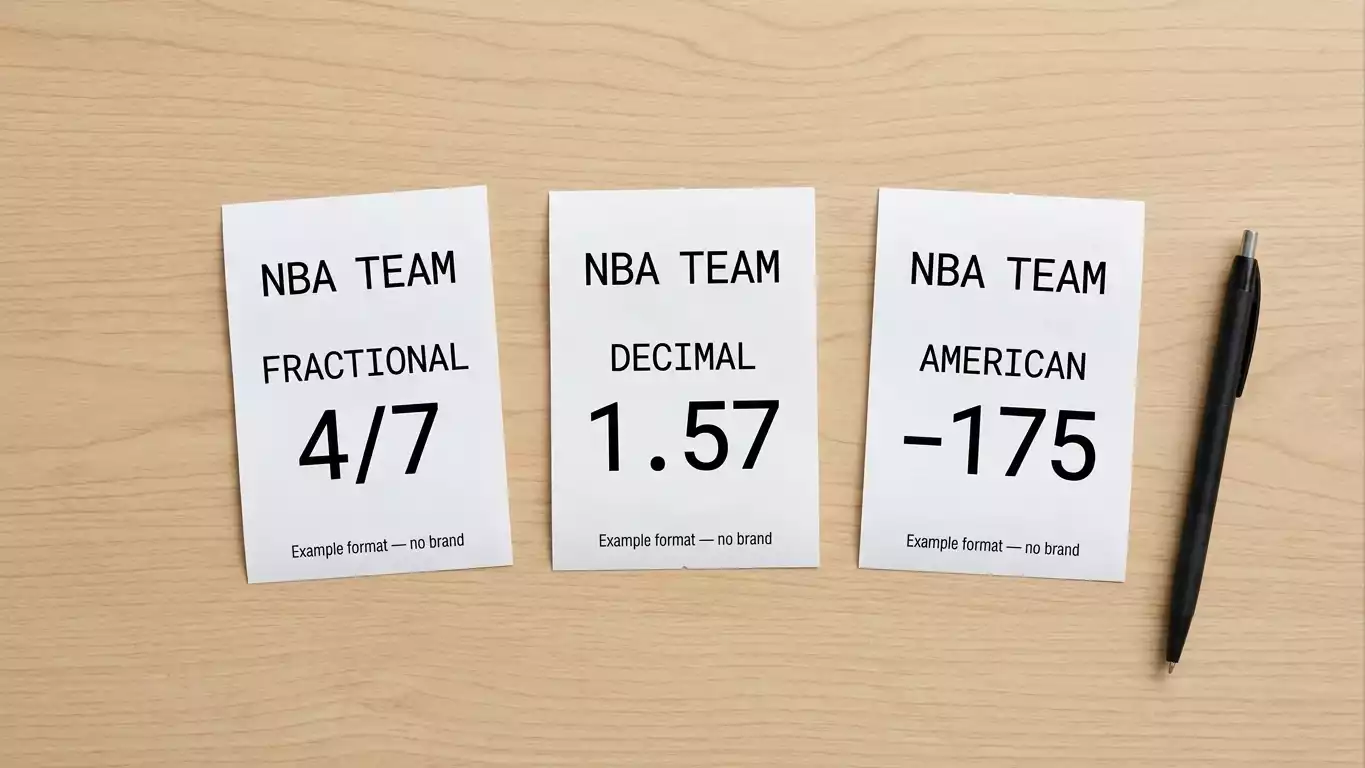
The formula, for the record, is straightforward. Kelly stake as a fraction of bankroll equals (bp – q) / b, where b is the net odds received on the bet expressed as a decimal multiple (so 5/2 is b = 2.5), p is your estimated probability of winning, and q is 1 – p. If you take a 5/2 price on a bet you assess at 40% probability, the calculation is (2.5 × 0.4 – 0.6) / 2.5 = 0.4 / 2.5 = 16% of bankroll. On a £1,000 bankroll, full Kelly would stake £160 on a single bet. That is an enormous stake for a UK retail bettor, and it is exactly what the formula tells you to do if your probability estimate is exactly right.
The problem is the word “exactly.” Your probability estimate is itself uncertain. If you estimate 40% but the true is 35%, full Kelly leads to systematic over-staking. Over a long series of bets the over-staking accumulates and the bankroll experiences catastrophic drawdowns that no professional risk manager would accept. Fractional Kelly fixes this by scaling the recommended stake down by a fixed factor.
Half Kelly is the most common professional choice. On the same 5/2 bet with 40% estimate, half Kelly stakes 8% of bankroll, or £80 on a £1,000 bankroll. Quarter Kelly, which stakes £40 on the same bet, is what I personally use for almost every Finals position. The cost in expected return is small. The reduction in variance is enormous.
Here is the worked example I run with every new client. You assess the Spurs at 3/1 as a true 30% probability to win the title. Full Kelly says stake 6.7% of bankroll — £67 on a £1,000 bankroll. Half Kelly stakes £33. Quarter Kelly stakes £17. Each step down halves the variance while reducing expected long-run growth by a smaller amount than you might think, because the relationship between Kelly fraction and expected growth is concave.
The practical Kelly stake for a UK Finals bettor with a strong read on a single outright sits between 1% and 3% of bankroll. Outside that range, you are either staking too small to capitalise on your edge or staking too large to survive a normal losing streak. Kelly is not magic — it is a guardrail against overconfidence dressed up in algebra.
How a £150 affordability check reshapes a Finals-week rhythm
A client I work with hit the £150 net-deposit threshold during Game 3 of a Finals series last year and was paused mid-session for a routine UKGC vulnerability check. He took it personally. I told him what I tell everyone in that position. The check is not a judgement on his betting. It is a regulatory requirement that applies to roughly 3% of active accounts, triggered automatically, and built into the operator licence. Knowing the threshold is going to interact with your Finals-week rhythm before it does is the difference between a smooth series and a frustrating one.
The mechanics are settled. From 28 February 2025, financial vulnerability checks for remote operators trigger at the £150 net-deposit threshold over a 30-day window, down from the previous £500. The check is what the regulator calls “light touch” — it relies on publicly available data such as County Court Judgements and bankruptcy records, and it does not require you to upload bank statements or payslips. Roughly 3% of active gambling accounts fall under the extended Financial Risk Assessment category according to UKGC publications, and the lighter vulnerability checks affect a similar share.
UKGC chief executive Andrew Rhodes framed the regulator’s position in February 2025, noting that total gross gambling yield had reached an all-time high of £15.6 billion while participation stayed stable at “48%, just under half of the adult population in Great Britain.” The check regime is part of the institutional response to a market growing in revenue while the regulator wants to keep participation flat and harm declining.
The practical implication for a Finals bankroll is that funding rhythm matters. If you plan to deposit £200 across the Finals run — well over the £150 threshold — you can expect the lighter vulnerability check to fire at some point during the series. To manage that without disrupting the staking plan, I recommend funding the bankroll once at the start of the series and not topping up. A single £200 deposit on the morning of Game 1 absorbs the check at a moment when nothing is at stake. A series of £30 top-ups across the series interleaves the check with active betting and creates exactly the disruption you do not want.
The check itself, when it triggers, typically resolves in under a working day for the vast majority of accounts. Some take longer. Some operators are smoother than others at communicating during the process. The cleanest approach is to maintain your account in good standing across the year — verified ID, current address, complete profile — so that when the check fires during a Finals week, the operator has nothing to query and the resolution is fast. The friction is real but bounded.
The bigger structural point is that affordability checks change the relationship between bankroll size and Finals-week stakes. If you are planning a £2,000 Finals bankroll, you are above the threshold by a comfortable margin and the check will fire. If you are planning a £100 Finals bankroll, you are below the threshold entirely and nothing changes. The £150 to £500 zone is the band where most UK retail bettors actually operate, and that band sits inside the threshold by design — the regulator chose the £150 mark specifically because it captures a meaningful share of active accounts without being so low that it disrupts casual play.
Drawdown discipline: how to survive an 0-3 start without compounding losses
An 0-3 start to a Finals week is the most dangerous moment in any UK bettor’s calendar, including the entire football season. The temptation to chase compounds with every loss. The unit size feels too small to recover with. The clock is short — there are only four games left and possibly only one. The body is tired because the games are in the middle of the night. Every condition for bad decision-making is present at the same time.
The discipline starts with a number you set before Game 1. Mine is 40%. If my Finals bankroll draws down by 40% before the series ends, I stop placing new bets for the duration. Not because the bets stop being justified by my model, but because a drawdown of that size means either my model is wrong or my sample is in a hostile run, and neither situation rewards continued staking. The 40% threshold is somewhat arbitrary — some traders use 30%, some use 50% — but the principle of having a circuit breaker is non-negotiable.
Inside the 40% threshold, the staking plan remains exactly as it was. £10 units stay at £10 units. If I am down £300 going into Game 4 on a £1,000 bankroll, I do not stake £50 on the next bet to recover faster. I stake £10 like I have on every other leg, because the only way to compound a bad series is to chase, and the only way to chase is to break the plan I set when I was thinking clearly.
The psychological move that helps most is to redirect the bet selection process rather than the stake. If the first three games have shown me that my read on the matchup was wrong, I should not stake more on the same bets — I should bet less, skip nights, or pivot to a different market where my read is fresh. There is no rule that you must place a bet on every game of the Finals. The professional position is that most games of most series are pass nights.
The other thing that helps is to write the drawdown plan in advance. I keep a Google Doc that lives in the same folder as my staking record. The doc says, in one sentence: if bankroll drops to £X, stop. If a single bet exceeds Y% of remaining bankroll, refuse it. If the night is past 2am and I have already placed two bets, no more bets tonight. Those rules are written when I am sober and rested. They get read when I am tired and tilted, and they hold because I have already committed to them.
The fourth and most important rule is that recovery happens between series, not within them. If you finish a Finals week down 30%, the recovery is the next series, not Game 6. Treating each Finals as a complete unit with a fixed bankroll and a fixed plan is what makes betting sustainable.
Splitting the bankroll across outright, series, single-game and prop markets
If there is one allocation question I get asked more than any other, it is how to slice a Finals bankroll between the markets available on the slip. The instinct most UK bettors have is to spread evenly — twenty-five percent on each of the four major market types — and that instinct is wrong, because the variance and edge profiles of those markets are not symmetric.
The allocation I run for myself and recommend to clients with a moderate bankroll looks roughly like this. Thirty percent of the Finals bankroll goes to outright entries placed before the series begins. Thirty percent goes to series-level bets — series winner, series correct score, series handicap — entered once both Finals teams are confirmed. Twenty-five percent goes to single-game bets placed within the series, including moneylines, spreads, and totals on individual games. Fifteen percent goes to player props and same-game parlays, with most of that fifteen percent reserved rather than committed early.
The reasoning behind the split has to do with where the edge sits. Outright bets are the longest-horizon bets with the highest variance but also the most opportunity to identify a price that is genuinely better than the underlying probability. The Spurs at 3/1 might be a 30% probability event in your model, and the price will move very little between October and June except in response to specific roster news. That makes outrights a low-frequency, high-quality entry market.
Series-level bets are the next-best edge zone because they aggregate a small number of games and the books often misprice the relative probabilities of 4-0, 4-1, 4-2 and 4-3 finishes. The historical distribution of NBA Finals series results is well-documented, and the books occasionally offer prices on a 4-2 finish that are noticeably looser than the historical base rate would suggest. Series correct score is one of the highest-margin markets on the entire Finals slip for the operator, which means it is also one of the markets where careful UK bettors find pockets of value.
Single-game bets are the highest-frequency entries but also the most efficient market. The books price moneylines and spreads on individual Finals games very tightly because the volume is enormous and the lines move quickly. The edge per bet is typically smaller than on outrights or series-level entries, which is why the allocation is correspondingly smaller.
Props and same-game parlays are the smallest allocation because the per-bet edge is the most variable. Some prop markets are demonstrably loose. Most are demonstrably tight. Reserving fifteen percent rather than committing it upfront lets you deploy capital opportunistically when a specific prop offers genuine value, and skip the rest of the prop slate entirely on nights when nothing looks attractive.
The reason the allocation does not split evenly is that the markets are not equally productive. The allocation above is a starting point — your own read on which markets you read well should adjust the percentages by five to ten points in either direction.
Deposit limits and time-outs: the guardrails the regulator built for you
Setting a deposit limit before a Finals series begins is the single highest-leverage discipline move a UK bettor can make, and it is also the one most casual bettors actively resist. The resistance is psychological. The limit feels like a vote of no confidence in your own judgement. Setting it anyway is what separates the bettors who survive long enough to compound from the ones who do not.
Every UKGC-licensed operator is required to offer daily, weekly and monthly deposit limits as part of their licence. Setting them is two taps in the account settings on any major UK book. The cooldown for increasing a limit is 24 hours by regulation, which means if you set a £200 weekly limit at the start of the Finals and try to raise it on Game 4 night, the new limit does not take effect for a full day. That delay is the entire point. The cooling-off period is built specifically to stop tilted top-up decisions.
Time-outs are the second-tier guardrail. A time-out is a temporary self-imposed account suspension running from 24 hours to six weeks. During the time-out the account is fully locked — no deposits, no withdrawals, no betting. I recommend setting an automatic 24-hour time-out the moment you finish a betting session, regardless of how it went. The friction of waiting before the next session forces a fresh decision rather than a momentum-driven one.
The data on uptake of these tools is grim and instructive. GamCare reported record numbers of helpline callers being referred to treatment in late 2025, with 1,165 referrals in October alone, 1,022 in September, and 1,077 in August. The pattern is consistent and rising. Through the first eight months of 2025, 1,151 people were referred to the GamCare Money Guidance Service compared with 923 across the whole of 2024, with combined debts exceeding £5 million. Those numbers describe people whose betting moved past the guardrails the regulator built. Setting limits proactively is what keeps you out of that data.
The technical details of how to configure limits, time-outs, and the broader self-exclusion regime through GAMSTOP are covered in detail in the GAMSTOP guide for UK NBA bettors. For this bankroll context, limits and time-outs sit at the bottom of a tool stack that escalates through to permanent self-exclusion. You do not have to be in crisis to use the lower tiers — they are calibrated for normal, healthy betting discipline.
Record-keeping: the closed spreadsheet that will save your season
The Google Sheet I have kept since 2018 has 4,127 rows in it. Each row is one bet. Each row has nine columns. Date placed, market, team or player, opening price in fractional, decimal equivalent, closing price at tip-off, stake in pounds, return in pounds, profit or loss in pounds. Nothing else. That spreadsheet is the single most valuable artefact in my professional setup, more valuable than any model or read or relationship with a tipster.
The reason record-keeping matters is that it is the only way to know whether you are actually any good. Memory is biased. Bettors remember their wins more vividly than their losses, and they remember bold reads more vividly than conservative ones. The spreadsheet does not. It shows the cumulative P/L across every bet, the win rate, the average price taken, and the implied probability of your entries. If those numbers do not paint a flattering picture, you have to face that rather than the one your memory is editing.
The minimum viable spreadsheet for a Finals run has six columns. Date. Market type. Team or player. Price taken in fractional. Stake. Result coded as win, loss, or void with the P/L in pounds. Decimal conversion can be added if you want to compute closing-line value later, but it is not essential for basic tracking.
The discipline that makes record-keeping work is to enter each bet at the time you place it, not at the end of the night. End-of-night entry introduces selection bias — you remember the bets that won and forget the small losses, or you round up the price you took to feel better about the trade. Real-time entry is what makes the record a record rather than a story.
Over a season of Finals and regular-season betting, the spreadsheet tells you which market type you are most profitable in, which fractional range produces your best returns, and whether your closing-line value is positive — the cleanest signal that you have edge. If you are taking 33% implied probabilities and winning 25% of those bets, the gap is your evidence that your model is overestimating your edge, and the gap is the size of the correction you owe yourself.
The spreadsheet is closed in the sense that nobody else sees it. It is a private audit tool. Show it to anyone and the temptation to edit it for narrative coherence creeps in immediately.
Maximize your playoff returns by following the premier UK guide to NBA Finals betting throughout the season.
Bankroll questions UK bettors ask before the Finals tip off
What percentage of a UK bankroll is reasonable to stake on a single NBA Finals game?
One to two percent of your dedicated Finals bankroll per single-game bet is the professional standard. On a £1,000 bankroll that is £10 to £20 per leg. Anything above three percent enters territory where a normal six-bet losing streak would draw you down 18% or more, which is recoverable but uncomfortable. The discipline of keeping the per-bet stake small is what lets you survive the natural variance of a seven-game series without panicking into bigger stakes.
How does a £150 affordability threshold change my staking plan during a Finals run?
If you plan to deposit more than £150 across a thirty-day window — which most Finals bettors will — expect a light-touch vulnerability check to fire at some point. The cleanest workaround is to fund the bankroll once at the start of the series rather than topping up across the week, so that the check resolves during a quiet moment rather than mid-session. Keep your account verified and up to date so that when the check fires it processes within a working day.
Should I use full Kelly or fractional Kelly when betting NBA Finals futures?
Quarter Kelly for almost everything, half Kelly only when your probability estimate is exceptionally well-evidenced, full Kelly essentially never. Full Kelly assumes you know your true edge precisely, which you almost never do. Quarter Kelly costs little in long-run expected return relative to half Kelly, and it dramatically reduces drawdown variance during a high-variance window like a Finals run. The reduced variance is worth more than the small reduction in expected growth, especially for a UK bettor who cannot afford a 40% drawdown to ride out without consequence.
Prepared by the nba Final Bets editorial staff.