NBA Finals Series Length Odds UK: Sweeps and Total Games
 Available in US
Table of Contents
- Pricing the NBA Finals Series Length Market
- Sweep versus gentleman’s sweep: what the market actually means
- The total games market and the 5.5 / 6.5 line
- What the historical base rate actually says about sweeps and game totals
- Pricing and where to look for value
- Combining series length with handicap and correct-score markets

Pricing the NBA Finals Series Length Market
The most overlooked corner of the UK NBA Finals board is the series-length market – the over/under on total games played, plus the sweep and gentleman’s sweep specials. It is overlooked because the products look exotic and the prices look long, but those long prices are precisely where the structural bookmaker margin is thinnest in percentage terms. The Thunder at -175 to -180 to win the 2026 title and the Spurs at +300 to +320 are both priced on dense liquidity. The corresponding “Thunder to sweep” market may not see another ticket for hours, which is exactly why a thoughtful UK bettor can sometimes find genuine value there.
The series-length market also rewards historical knowledge in a way the headline markets do not. The over/under on 5.5 or 6.5 total games has a hard empirical anchor: the actual game-count distribution across NBA Finals history. UK trading desks build that anchor into their pricing, but they have to make assumptions about how the current matchup deviates from history – and those assumptions are where bettors with their own read can find spots the model has missed.
Sweep versus gentleman’s sweep: what the market actually means
A sweep on the NBA Finals is a 4-0 series victory by either side. A gentleman’s sweep – the term has slang origins but appears on serious UK book menus – is a 4-1 series victory, where the losing team takes one game so as not to leave empty-handed. Some UK books list a separate “either team to sweep” market that combines both 4-0 outcomes, others list directional sweep markets where you pick which side does the sweeping. Read the product carefully before you stake, because the price differences between the two formats are large and reflect different implied probabilities.
The terminology matters because UK books occasionally combine markets in ways that look similar but pay differently. A “Finals over 4.5 games” market settles on whether the series goes to a Game 5 or beyond, which is functionally a bet against a 4-0 sweep. A “sweep – yes/no” market on the same series typically pays out as a binary, and the implied probabilities should reconcile across the two markets. When they do not reconcile – when the implied probability of a sweep from the binary market differs from the implied probability calculated from the over/under price – there is sometimes a small cross-market arbitrage opportunity, though stake caps usually limit how much value the bettor can extract.
The total games market and the 5.5 / 6.5 line
UK books typically post the total games line at either 5.5 or 6.5 depending on the perceived competitiveness of the matchup. A 5.5 line means the bookmaker is treating six games as the modal outcome – bet the over and you win on a six-game or seven-game series. A 6.5 line means the bookmaker is treating seven games as more likely than not – bet the over and you only win on a seven-game series. The choice of line itself signals the bookmaker’s read.
For the Thunder against most plausible 2026 opponents, UK books are likely to post a 5.5 line reflecting their favourite status – six games being the expected outcome if the Thunder win in their favoured pace. For more competitive projected matchups like an East-conference final against a Cavaliers or Knicks team that has built playoff momentum, the line may move to 6.5 or even to 6.5 with a “draw” carve-out where a six-game series voids both sides.
The over/under typically prices both sides between -130 and +110 in American format, equivalent to 1.77 to 2.10 decimal. The narrow price band reflects how close to even-money the bookmaker views the total-games question for most matchups. That narrow band is also where UK bettors with a strong directional read on series length can find their best edges – a half-point of difference between fair-value implied probability and the offered price translates to meaningful long-run value when accumulated across enough bets.
What the historical base rate actually says about sweeps and game totals
The empirical record on NBA Finals series length is unambiguous on a few points. Sweeps are rare. The last completed Finals sweep was Golden State’s 4-0 over Cleveland in 2018, and before that you have to go back to 2007 for the Spurs sweeping Cleveland. Across the modern NBA Finals era from 1980 onward, sweeps have occurred in roughly 11 to 12 per cent of series – meaning at the long-run rate, a fair price on “either team to sweep the Finals” would be around 7/1 fractional or +700 American.
UK books typically price either-team sweeps at around 5/1 to 6/1 – implied probability of 14 to 17 per cent – which is shorter than the long-run empirical rate suggests. The reason is that the long-run rate includes lopsided matchups that the current parity era produces less frequently, balanced against an offsetting effect that within any specific matchup, the team that is heavily favoured has a meaningfully higher sweep probability than the league-wide average. Whether a sweep price is fair value depends on the specific matchup, not on the headline empirical rate.
The over/under on 5.5 games has its own empirical anchor. Across the modern era, Finals series have gone to six games or beyond in roughly 60 per cent of cases, and to seven games in roughly 30 per cent. That gives a fair-value implied probability for the over 5.5 line of around 60 per cent – equivalent to -150 American or 1.67 decimal. UK books that post the over 5.5 at -130 to -140 are offering small but real value relative to the historical baseline, assuming the current matchup is broadly typical.
The wider context for these patterns is the parity era. With unique champions every year since 2019 – the longest such streak in league history – Finals matchups have skewed toward competitive seven-game series. Six of the past seven Finals have reached at least Game 5, and three have gone the full seven. The historical base rate is therefore arguably understating the over 5.5 fair value for matchups within the parity-era regime. UK trading desks have updated their priors in this direction, but the update is partial and conservative.
Pricing and where to look for value
The series-length value windows tend to open in two specific scenarios. The first is when the matchup heavily favours one side and the bookmaker has anchored the over/under line to a league-wide average rather than a matchup-specific projection. A Thunder team that is -175 to win the title is more likely to produce a short series than a generic Finals participant, and the under 5.5 in such a matchup carries higher implied probability than the headline line suggests.
The second window opens when the matchup features two teams with high playoff variance – typically the East-versus-West Finals where the Western team has had a relatively easy playoff path and the Eastern team has emerged from a more competitive bracket. These matchups historically produce longer series than the favourite price implies, because the underdog has accumulated game-pressure experience that the favourite has not. The over 5.5 or over 6.5 line in such matchups is the natural value play.
The wider cultural backdrop matters too – Andrew Rhodes speaking for the UK Gambling Commission noted that Discussions with operators are showing a widening out of the sports offering in particular, with sports beyond the traditional horseracing and football growing in use, such as cricket, basketball, NFL and a host of other US-based sports.
That growing UK basketball volume means more liquidity is flowing into series-length markets than was the case five years ago, and the prices on those markets are becoming more competitive across UK books. Comparison-shopping series-length lines now pays off in ways it did not pre-2023.
Combining series length with handicap and correct-score markets
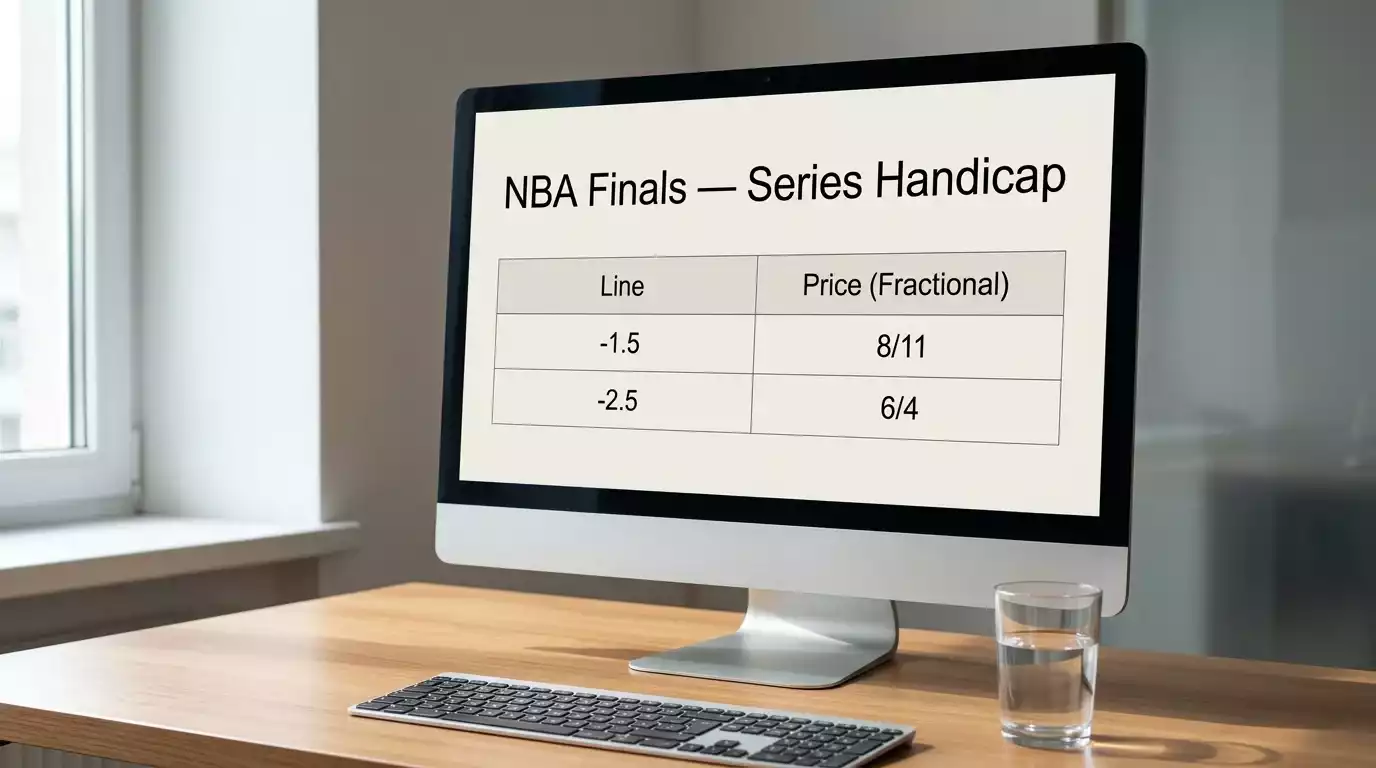
The most efficient way to extract value from series-length markets is to combine them with handicap or correct-score bets that share the same underlying view. A bettor who thinks the Thunder will win in six games can express that view through three different products: the correct score 4-2 in the Thunder’s favour, the under 6.5 total games combined with the Thunder series winner, or the series handicap at -1.5 on the Thunder.
Each product prices the same scenario differently because of the overround structure. Correct score typically carries the widest overround – 115 to 120 per cent for the full eight-outcome distribution – but pays the longest odds on a successful pick. The combined under/series-winner ticket carries less overround but ties the two outcomes together as a single bet. The series handicap typically has the tightest overround at around 105 to 110 per cent but pays the shortest odds.
The bettor’s job is to identify which product offers the best price for their specific scenario. In matchups where the bookmaker has anchored the series-length over/under to a league-wide average, the handicap or correct-score markets sometimes price the same scenario more efficiently than the explicit total-games market. The disciplined approach is to calculate the implied probability of your scenario from each available product and bet whichever product is offering the longest odds on that implied probability. The mechanics of the four-outcome correct-score grid – 4-0, 4-1, 4-2, 4-3 in either direction – sit in our correct score 4-1 4-2 piece.
Which NBA team last completed a Finals sweep, and how rare are they historically?
The last completed NBA Finals sweep was Golden State’s 4-0 victory over Cleveland in 2018. Before that, the previous sweep was San Antonio over Cleveland in 2007 – an 11-year gap between sweeps. Across the modern Finals era from 1980 onward, sweeps have occurred in roughly 11 to 12 per cent of series, making them genuinely rare outcomes that UK books price accordingly.
What is a ‘gentleman’s sweep’ on NBA Finals?
A gentleman’s sweep is a 4-1 series victory, where the losing team takes one game so as not to be swept entirely. The term has slang origins but appears on UK book menus as a separately priced market. Some books list it under correct-score 4-1, others as a standalone ‘gentleman’s sweep – yes/no’ market with its own implied probability distinct from the broader correct-score offering.
Prepared by the nba Final Bets editorial staff.