NBA Finals Price Boosts UK: Enhanced Odds and Bet Specials
 Available in US
Table of Contents
- Evaluating NBA Finals Enhanced Odds Value
- How a price boost is built behind the scenes
- Boost versus promo: two different products often confused
- How to value-check a boosted NBA Finals price in 30 seconds
- Stake limits and why they matter more than the headline boost
- The Finals boost calendar and where the genuine value lives
Evaluating NBA Finals Enhanced Odds Value
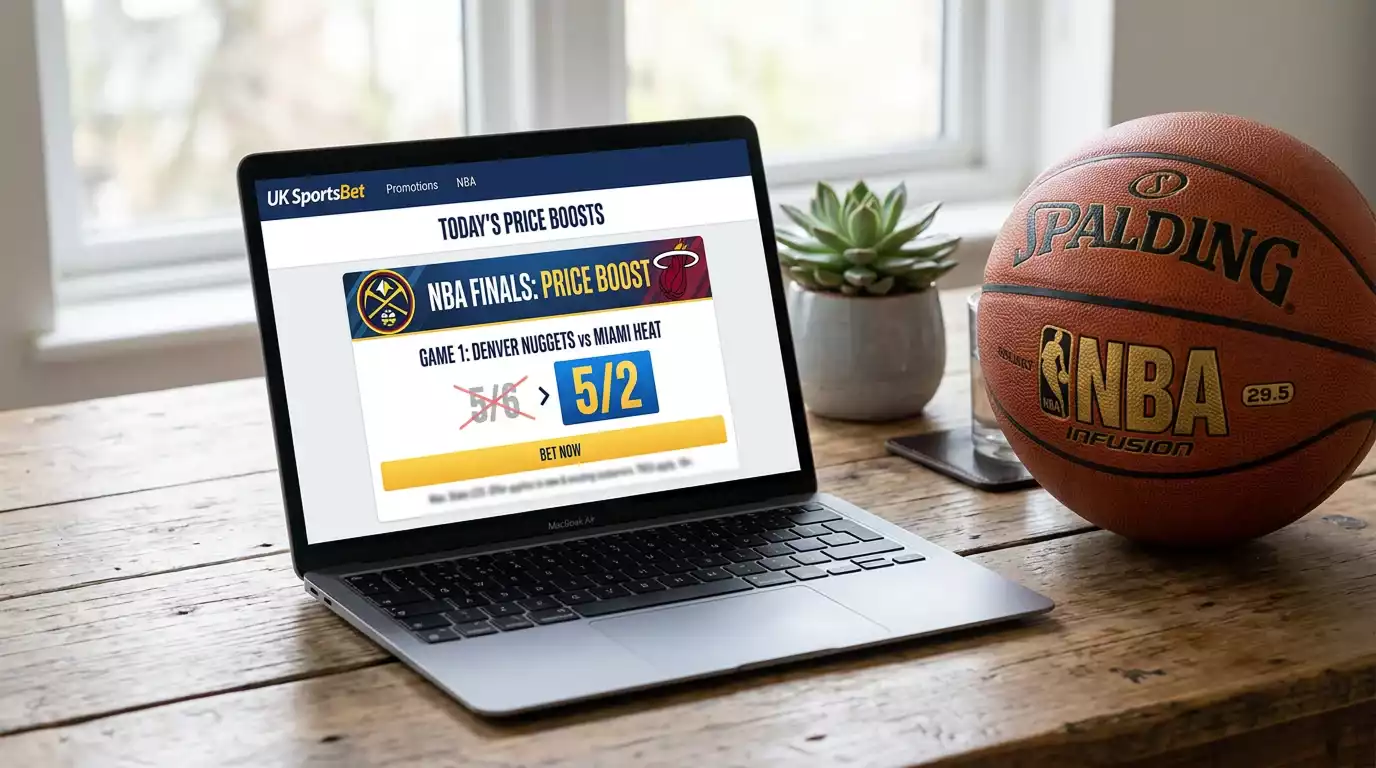
I keep two screenshots on my desktop as a reminder. The first is a UK app’s promoted “Thunder to win 2026 Finals – boosted to 11/8” offer from earlier this season. The second is a similar offer from a different book – “Thunder to win Finals – boosted to 4/5” – three months later. The first looked dramatic. The second looked unremarkable. The first was a price-boost on an unrealistic underdog scenario that the bookmaker had no intention of letting you bet meaningfully. The second was a quiet boost on a market the book genuinely wanted action on, with no stake cap, and a small but real positive expected value to the bettor who took it.
Reading price boosts correctly is one of the higher-value skills a UK Finals bettor can develop, because the boost market is where marketing teams and trading teams negotiate over your attention. With the Thunder at -175 to -180 across UK books for the 2026 title, the natural fair price for boosted offers around that team should sit between 0.4 and 0.5 fractional. Boost offers significantly longer than that are usually marketing-driven, not value-driven. The bettor’s job is to tell the difference quickly.
How a price boost is built behind the scenes
A UK price boost is not a free gift. It is a marketing budget item allocated against a specific market, with a calculated maximum exposure the book is willing to accept on that boosted line. The marketing team specifies the headline number they want to advertise – “boosted from 5/4 to 7/4” – and the trading team calculates the maximum stake at the boosted price that keeps the book’s overall exposure within acceptable limits.
The result is what you see on the app: a promoted offer with a headline boost and a stake cap, often as low as £5 or £10. The cap is not arbitrary. It is the number that makes the boost economically viable for the book given their internal margin targets. A £5 cap means the book is willing to accept perhaps 50,000 bets at the boosted price for a total exposure of £250,000, with an expected loss they have budgeted into the marketing line item. Above the cap, the price reverts to the standard market price and the boost no longer applies.
The economic context is the UK online sector – gross gambling yield of around £7.8 billion, online accounting for 46 per cent of the industry – which gives you a sense of the marketing budgets involved. Price boosts are a meaningful component of UK book customer acquisition strategy, and the boost rate cards are calculated against acquisition cost per customer rather than against ex-ante positive expected value for the bettor.
Boost versus promo: two different products often confused
UK bettors frequently lump price boosts in with the broader category of promos, but they are structurally different products. A boost is a price improvement on a specific market – the headline odds are mathematically better than the standard market price. A promo is a behavioural reward – free bets, refunds on losing bets, accumulator bonuses, deposit matches. A boost makes a specific bet more valuable. A promo makes a specific behaviour more rewarding.
The two get confused because they often appear in the same marketing module on UK apps, and the visual treatment is similar. The economic effect for the bettor is different. A boost delivers value immediately if you take the boosted bet, but only on that bet. A promo delivers value contingent on completing a sequence of bets that match the promo’s terms. Most UK promos have wagering requirements, minimum-odds requirements, or time limits that reduce their actual value relative to the headline.
The behavioural trap with both is the same. If a boost or promo nudges you toward a bet you would not otherwise have placed, the marketing has worked even if the bet itself was negative-expected-value. The right framing is to identify the bet you would place at standard odds, then check whether a boost or promo improves the expected value of that specific bet – not the other way around.
How to value-check a boosted NBA Finals price in 30 seconds
Every boost offer needs a quick value check before you take it. The check has three steps and takes about 30 seconds once you have done it a few times. Step one: convert the boosted odds to implied probability. A boost from 5/4 (decimal 2.25) to 7/4 (decimal 2.75) implies a probability shift from 44.4 per cent to 36.4 per cent. Step two: compare that implied probability to the current best market price for the same outcome across other UK books. If the best alternative is 6/4 (decimal 2.50, implied 40 per cent), the boost has genuine value.
Step three: subtract the bookmaker overround. UK NBA Finals markets typically run with an overround of 105 to 115 per cent, meaning the sum of implied probabilities across all outcomes exceeds 100 per cent by 5 to 15 per cent. A boost that takes the implied probability below the fair-value implied probability – accounting for that overround – is genuinely positive expected value. A boost that merely moves the price closer to the fair-value implied probability is marketing without substance.
For the Thunder at -175 to -180 example, the fair-value implied probability sits around 64 per cent. A boost on a Thunder-related market that prices the implied probability below 60 per cent is offering genuine value. A boost that prices the implied probability at 65 per cent is offering nothing – the book is calling the original market price too short and using the boost as a way to attract action toward a price they would have offered anyway in a fairer market.
Stake limits and why they matter more than the headline boost
The stake limit attached to a boost is usually the single most important piece of information about the offer, and it is also the piece most bettors skim past. A boost from 5/4 to 7/4 with a £5 maximum stake is offering you a maximum upside of £8.75 – useful but limited. The same boost with a £100 maximum stake is offering a maximum upside of £175. The headline boost is identical in both cases. The economic significance to a bettor with non-trivial bankroll is wildly different.
UK books vary widely on their boost stake caps. Some books routinely offer £25 to £100 maximum stakes on price-boosted markets, particularly for established customers who have demonstrated betting patterns the book considers acceptable. Other books cap boosts at £5 or £10 across the board. The difference reflects each book’s customer acquisition strategy and their internal exposure budget for promotional pricing.
One practical tip: stake caps are usually visible in the offer terms, but they are sometimes buried in a click-through link or a separate promotions page. Before you take any boost, find the stake cap. If it is not clearly displayed, assume the cap is low. Books that want you to take large stakes on a boost will tell you the cap up front.
The Finals boost calendar and where the genuine value lives
UK price boosts on NBA Finals follow a predictable annual calendar. The first significant wave of boosts hits in early October when the new season opens, coinciding with the offseason refresh of betting markets and the marketing teams trying to recapture customer attention after the dead summer. October boosts tend to be heavy on futures markets – Finals winner, MVP futures, conference winner – because those are the products with the longest dead time and the biggest carry cost for the book.
The second wave hits in February and March as the playoff picture clarifies. These boosts are more specific – series winner on plausible playoff matchups, correct-score markets on the most likely Finals matchups, anytime scorer markets on emerging stars. The third and largest wave hits in the two weeks before Finals tip-off, when marketing budgets are concentrated on the highest-profile event of the season and competition for new customers peaks.
The genuine value in the boost calendar is typically in the October wave on outright markets. Bookmaker confidence on title odds is weakest in October – there is the most variance left in the season – and the marketing pressure to attract preseason action is highest. October Thunder or Spurs boosts at meaningfully better-than-fair-value implied probabilities do appear, and a UK bettor who shops aggressively can pick up small genuine edges. The Finals-week boosts are the worst value as a category – the marketing pressure is highest but the trading desks have most information, and the gap between marketing-friendly headline boost and genuine fair-value tends to widen. For more on how to shop UK books generally against the aggregator approach, the workflow piece sits in our oddschecker vs direct uk sportsbooks nba piece.
Are NBA Finals price boosts usually +EV for the bettor?
A minority are. Most price boosts move the headline odds in the bettor’s favour but stop short of overcoming the bookmaker overround, which means the boosted price is still negative expected value relative to fair odds. The boosts that genuinely deliver positive expected value tend to be on October preseason markets where bookmaker confidence is lowest and marketing pressure is highest. A 30-second value check against the best alternative market price is the only reliable filter.
What stake limits typically come with boosts?
UK price boost stake caps range from £5 to £100 depending on the book, the customer’s betting history, and the specific market. Casino-first books with smaller sportsbook divisions typically cap at £5 to £10. Established UK sportsbooks for known customers may extend caps to £25 to £100. Stake caps are usually disclosed in the offer terms – if they are not clearly displayed, assume the cap is low.
Published by the nba Final Bets team.