Laying NBA Finals Bets UK: Betfair Exchange Hedging
 Available in US
Calculating Betfair Commission and Hedging Math
I had a Boston Celtics outright ticket placed in October at 10/1, and by mid-May they were 11/4 to win the title. Most UK bettors in that position do nothing and wait for the variance to play out. I went to Betfair Exchange and laid them at 11/4. Locked in a guaranteed profit no matter what happened from there. It wasn’t elegant – the maths is fiddly and the commission cost real – but it was the only way to turn a paper position into a sealed result. The sportsbook had no equivalent product. The exchange did.
Laying a bet means taking the role of the bookmaker – you’re betting against an outcome rather than for it. Betfair Exchange is the largest UK-facing venue for this. Smarkets and Matchbook offer the same product at slightly different commission rates. For NBA Finals futures held for months, exchange laying is the cleanest tool for hedging that exists in the UK regulated market.
This article walks through back-versus-lay mechanics, how Betfair’s commission structure actually bites, the hedging maths in pound-by-pound terms, why NBA liquidity is thinner than you might expect, and a worked example of taking a long-hold outright to a sealed-profit exit.
Back vs Lay Basics
On a traditional sportsbook, you back outcomes: Thunder to win the title at 4/7. Your stake is at risk; the book pays you if you’re right. The book’s role is to be on the opposite side of every bet – it lays, you back.
On Betfair Exchange, you can play either role. If you back Thunder at 4/7, your stake is at risk in the standard way. If you lay Thunder at 4/7, you’ve put up the liability – meaning if Thunder win the title, you pay out the equivalent of someone else’s £100 backing at that price (you pay £57 in profit terms). If Thunder lose, you keep their £100 backing stake as your winnings. The exchange takes commission on the net winnings only.
The mental flip takes some time. When you back, you risk your stake to win a multiple. When you lay, you risk a multiple to win an amount equal to someone else’s stake. Specifically, laying at 4/7 means you risk £4 to win £7 (the opposite of what backing at 4/7 means). Laying at 4/1 means you risk £4 to win £1. Laying at 1/4 means you risk £1 to win £4.
The intuition: laying short prices is what makes money on heavy favourites who don’t get there. Laying long prices is what makes money on persistent longshots that never quite land. The risk profile flips relative to backing – laying short prices means you risk a lot to win a little, with a high hit rate. That’s the trade-off.
Commission Structure
Betfair Exchange charges commission on net winnings on a market-by-market basis. The standard rate is around 5% for most users, with lower rates available through the Betfair Points loyalty system and the Premium Charge for very profitable users. The commission is taken from the winnings only – you never lose more than your liability on a losing market.
For NBA Finals futures, the 5% commission rate adds up. A £200 lay at 4/1 that lands pays you £200 in winnings; commission of £10 leaves £190 net. Over a season of multiple hedge positions, the commission cost can compound to a meaningful slice of overall P&L.
Smarkets, the competitor exchange, runs at around 2% commission, which can make a difference on larger volumes. Matchbook runs at around 2% for sports markets. The trade-off is that Smarkets and Matchbook have thinner liquidity than Betfair on NBA markets, so the commission savings can be offset by the slippage cost of getting filled at worse prices.
UK Remote Gaming Duty rises from 21% to 40% from April 2026, and the new 25% Online Sports Betting Duty arrives in April 2027 to replace the current 15% General Betting Duty. Exchange operators are not exempt from these duties, so the commission rates may rise as the tax burden grows. For long-hold positions, locking in the lay early – before any commission changes filter through – can be the right call even when the price isn’t perfect.
The Hedging Calculator
The maths of locking in profit through a lay is straightforward once you’ve done it twice. Suppose you backed Team A at 10/1 with a £20 stake in October. Total return if they win: £200 profit plus £20 stake back = £220. By Finals time, Team A’s market price has shortened to 11/4 to win the title.
To equalise your P&L across both outcomes (Team A wins or Team A loses), you lay Team A on the exchange at 11/4. The amount you lay needs to balance the upside of the original back against the cost of the lay. Formula: lay stake = (back stake × back odds) / lay odds. So lay stake = (£20 × 11) / (11/4 expressed as decimal, which is 3.75) = £220 / 3.75 = £58.67.
Let’s check the maths. If Team A win the title: you collect £200 profit from the back, you pay out £58.67 × (3.75 – 1) = £161.34 in lay liability. Net profit: £200 – £161.34 = £38.66, minus commission on the back winnings of about £10 (your sportsbook doesn’t charge commission, so this is just for the lay side which lost). If Team A lose the title: you lose your £20 back stake, you collect £58.67 lay winnings minus 5% commission = £55.74. Net profit: £55.74 – £20 = £35.74.
Both scenarios pay you about £36-39, give or take commission and rounding. You’ve taken the outcome variance off the table and locked in a profit. The cost is the gap between the two scenarios (a couple of pounds) and the lay liability you’ve tied up.
Liquidity in NBA Markets
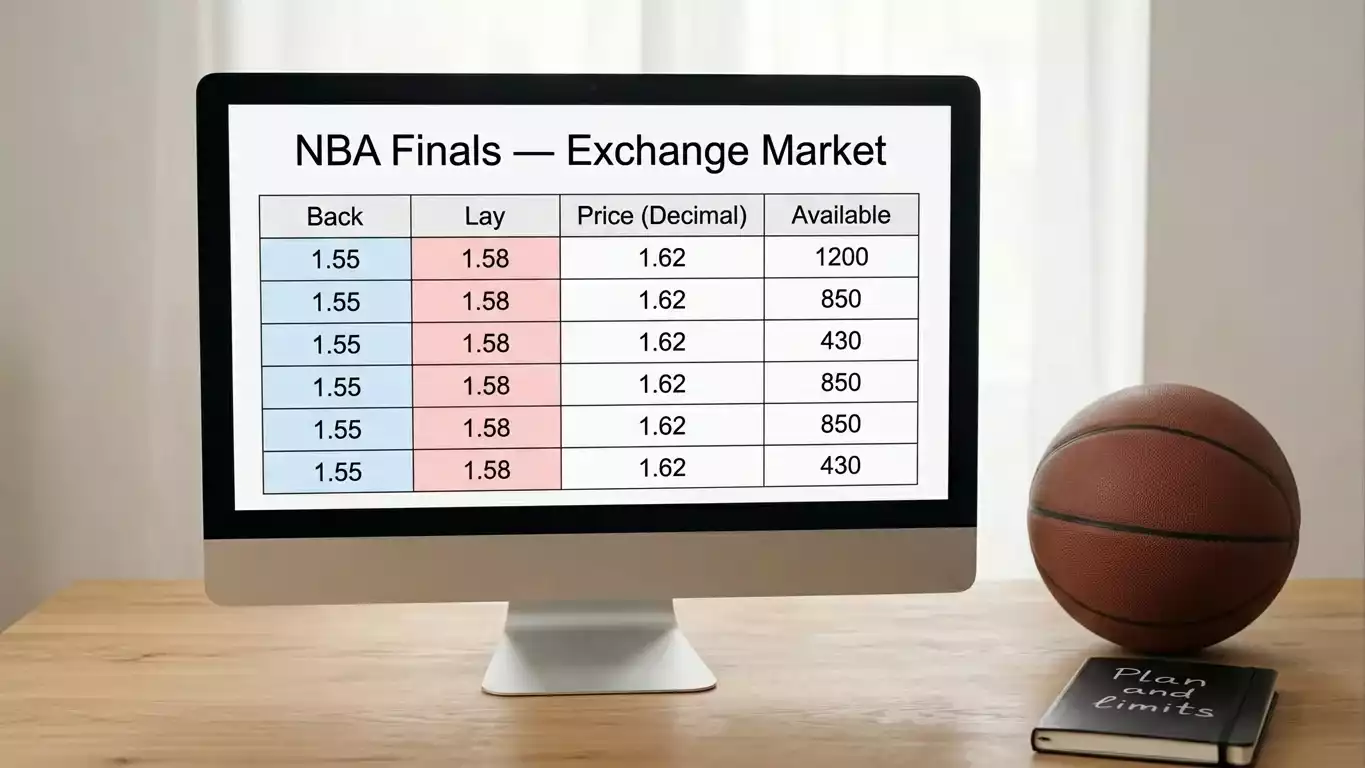
Exchange liquidity for NBA Finals is significantly thinner than for Premier League or horse racing. Betfair’s NBA Finals outright market typically has between £50,000 and £200,000 matched across the playoff window, compared to £5-10 million on a Premier League outright. That liquidity gap is structural – football is the UK’s dominant betting product, and basketball is still building.
What thinner liquidity means in practice: the gap between back and lay prices is wider, and large stakes move the market. A back price of 4/1 on Team A might have a corresponding lay price of 9/2 – a noticeable spread. If you want to lay £500 at 4/1, you might find only £200 available at that price; the rest fills at 9/2 or 5/1, moving your effective price worse.
The remote sector GGY in the UK reached £7.8 billion in the year to March 2025, with online accounting for 46% of the industry. Exchange volume is a small subset of that total – the major operators dominate by stake volume – but the exchange market for NBA has grown alongside the 24% increase in the UK NBA fan base since 2022. The liquidity is improving year on year, but still doesn’t compare to football.
Practical implication: for £500+ exchange stakes on NBA outrights, place orders rather than taking the market price. Set a lay order at the price you want, let it sit, and wait for someone to back into it. This avoids the slippage of taking thin market prices and often improves your fill by 5-10 percentage points of implied probability.
Worked Example: A Real Hedge
Here’s a worked example using actual current numbers. Cleveland Cavaliers were trading at +5000 American (about 50/1 fractional) at the start of the season. After their 125-94 Game 7 win over Detroit Pistons, the price moved to +2000 American (about 20/1 fractional). Say you took the 50/1 with a £10 stake. Total upside if they win: £500 profit.
To hedge at the new 20/1 price (which on Betfair Exchange will be a back price of 21.00 decimal and a lay price of around 22.00 due to the spread), you’d calculate: lay stake = (£10 × 50) / 22 = £22.73 to equalise. If Cavaliers win the title: you collect £500 profit from the back, pay out £22.73 × 21 = £477.30 in lay liability. Net: £500 – £477.30 = £22.70. If Cavaliers lose the title: you lose your £10 back stake, you collect £22.73 lay winnings minus 5% commission = £21.59. Net: £21.59 – £10 = £11.59.
The hedge isn’t perfectly equal because of commission and the back-lay spread, but it locks in a £12-23 profit regardless of outcome – turning a £10 stake into a guaranteed double-up. The 14-game playoff window from here to the Finals is the variance you’ve removed from your position.
For Thunder, who sit at -175/-180 in US books (around 4/7 fractional on UK books), the lay maths gets harder because you’d need a much larger liability to hedge a small original stake. That’s the structural feature of laying short prices: the liability is multiples of the original stake. Lay at 4/7 a £20 original at 10/1 backing would require £100 × (7/4 + 1) = around £190 in liability for a small total profit. The hedge often makes sense on long-hold longshots that came good, not on heavy favourites that stayed favourite. The price-discovery and execution side of this – where you find the best lay before you commit – is covered in Oddschecker vs going direct for UK NBA prices.
What commission does Betfair Exchange charge on NBA Finals markets?
The standard Betfair Exchange commission rate is around 5% on net winnings. The rate can be lower through Betfair Points loyalty discounts. Commission is taken from the winnings only, never from the liability. Smarkets runs at around 2% and Matchbook at around 2% for sports markets, but both have thinner NBA liquidity than Betfair.
Why is exchange liquidity thinner on NBA Finals than on Premier League football?
Football is the dominant UK betting product by stake volume, so exchange liquidity follows. NBA Finals outright markets on Betfair typically see £50,000 to £200,000 matched across the playoff window, compared to several million on a Premier League outright. The gap is structural and reflects the smaller UK basketball audience, though the NBA fan base in the UK has grown 24% since 2022.
Prepared by the nba Final Bets editorial staff.