NBA Finals Same Game Parlay UK: Bet Builder Strategies
 Available in US
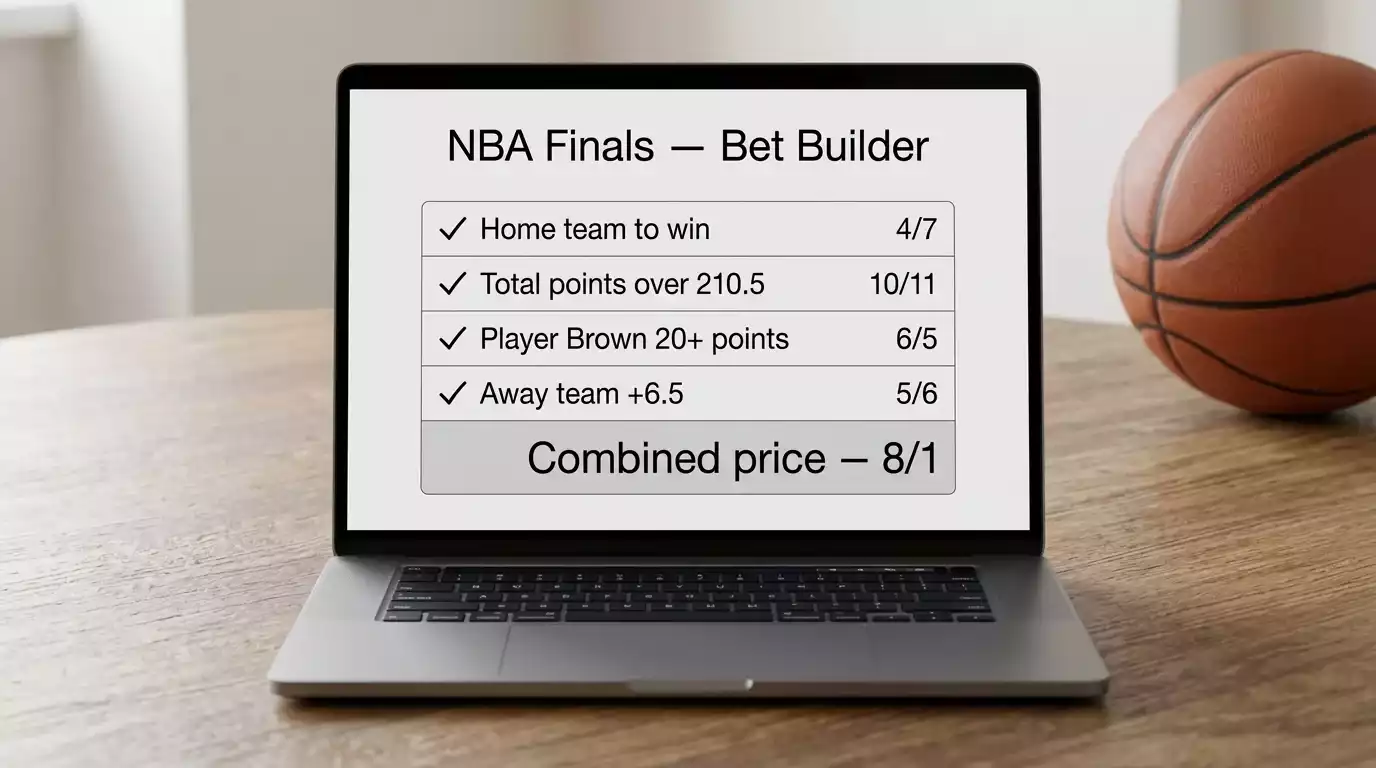
Analyzing Correlated Legs in NBA Bet Builders
A new UK bettor I was helping last summer built a 5-leg Bet Builder on a Finals Game 2: Thunder to win, over 215.5 total, Shai Gilgeous-Alexander over 27.5 points, Jalen Williams over 18.5 points, and a Thunder -4.5 spread. The slip priced up at 12/1. He was thrilled. I asked him what the price would have been if the legs were independent. He didn’t have an answer. The book did: roughly 22/1. The correlation tax – what the bet builder takes off the price because the legs are connected – was almost half the theoretical return.
Same-game parlays (SGPs), or Bet Builders as bet365 and Paddy Power call them, are the fastest-growing product in UK basketball betting. They let you combine legs from a single game into one stake with a single combined price. The appeal is obvious – small stake, big possible return, all wrapped in one slip. The maths underneath is less obvious, and the UK operators have spent a lot of money making sure the slip-builders look friendly enough that you don’t ask.
This piece walks through what SGPs really are, how correlation pricing works, what a typical Finals builder actually looks like, the structural mistakes UK bettors make on the slip, and what cash-out is actually doing when it’s offered mid-game.
When constructing your bet builders, adding NBA Finals player props like anytime scorers can significantly boost your potential payout.
SGP vs Traditional Parlay
A traditional parlay (or accumulator, in the older UK phrasing) combines legs from different events. Three Premier League winners, two NBA games – all stacked into one bet where every leg must land. The combined price is the simple product of the individual decimal prices, because the legs are statistically independent.
A same-game parlay combines legs from one event. Three legs from a single Finals Game 4: Thunder to win, over 215.5 total, SGA over 27.5 points. The legs are not independent. If Thunder win, they probably scored a lot, which feeds the over. If SGA scored 30+, Thunder probably won. The correlation between legs means the simple multiplication of independent prices would overstate the true combined probability – i.e. would pay too much.
UK operators handle this by recalculating the combined price using a correlation-aware model. The bet builder doesn’t just multiply prices; it asks “what’s the joint probability of all these legs hitting together?” and prices to that joint probability with a margin layered on top. The result is always shorter than the naive multiplication – sometimes by 20%, sometimes by 50% – depending on how correlated the legs are.
The Correlation Effect on Pricing
The simplest correlated pair on NBA: team to win plus over the total. These two legs are positively correlated – winning teams tend to score more – so the joint probability is higher than the product of the individual probabilities. A naive parlay calculation would multiply 1.80 (Thunder to win at evens-ish, 56% implied) by 1.91 (over the total, 52% implied) and get 3.44 combined price, implying 29% probability. The real joint probability – calibrated against historical data – is closer to 35-38%, so the fair combined price is somewhere around 2.65-2.80. UK books typically price the combined leg at around 2.50, taking their margin on top of the correlation adjustment.
Now stack three correlated legs: team to win, over the total, and team’s leading scorer over his points line. All three are positively correlated. The joint probability is much higher than the independent product, so the combined price compresses dramatically. What would have been 6.50 in independent multiplication might price at 3.50 in the bet builder. The bettor sees a “shorter” price and feels short-changed; the book is actually pricing the bet correctly because the events are nowhere near as rare in combination as they are individually.
The opposite case – negatively correlated legs – is rare but instructive. A bet that combines team A to win with team B’s leading scorer over his points line is mildly negatively correlated (team B losing tends to mean fewer minutes or worse efficiency for their star). The combined price will be longer than naive multiplication suggests. UK books still price this case, but the margins are tighter because the bet builder’s correlation model has more work to do.
OKC Thunder are currently trading at -175/-180 in US books (about 4/7 fractional in UK terms, 63.6% implied). Pair that with a Thunder over team total bet and the correlation tax is real – you’ll see the joint price compressed by roughly 20-25% from where naive multiplication would put it.
Typical Finals Bet Builders
Walk through three Bet Builders you’ll see on UK books during a typical Finals game. Builder one – the conservative stack: Thunder to win, both teams over 100 points, SGA to record a double-double. Three legs, two of them very likely (Thunder winning at 4/7, both teams scoring 100+ in a Finals game is almost always yes), one moderate (SGA double-double at evens-ish). Combined price: typically 3/1 or 4/1. Honest, low-variance, no obvious edge.
Builder two – the popular stack: Thunder -4.5 spread, over 215.5 total, two players to combine for over 50 points. Three legs, all moderately probable, all positively correlated. Combined price: typically 5/1 to 7/1. This is the format most UK bettors actually build because the legs feel “researched.” The correlation tax is heaviest here.
Builder three – the trap stack: Thunder to win, OKC top scorer to score over 30, OKC to lead at every quarter, total 1H over 110. Four legs, all heavily positively correlated. Combined price: maybe 8/1. The bet builder is essentially asking “Thunder to dominate from the start” – and pricing it as if the four legs were nearly-independent confirmations. They aren’t. They’re one bet repeated four times. The 8/1 looks fat. The fair price for the genuine independent question – “does Thunder dominate?” – is more like 5/1.
This is where I get strict with myself. If I can describe my four-leg builder in one sentence (“Thunder dominate,” “shootout game with high scoring on both sides”), it’s not really a four-leg bet, it’s a one-leg bet wearing a costume. I’d rather take the cleanest version of that one bet at its fair price than the costumed version with three free correlation slices.
Common Mistakes With SGP
The first mistake is the “more legs equals more value” instinct. It doesn’t. Every leg added to a bet builder narrows the joint probability and also adds a slice of the book’s margin. A 5-leg builder typically carries a combined overround of 15-20% – about twice what a single-leg moneyline carries. The break-even hit rate on a 5-leg builder is brutal even before variance.
The second mistake is treating the displayed price as if it were the independent calculation. UK books rarely show the breakdown – you see the combined number and a list of legs. Backwards-engineering the correlation adjustment is hard. Easiest discipline: if the combined price is more than 1.5x what you’d get on a single moneyline of comparable confidence, you’re paying too much for the structure.
The third mistake is loading correlated legs without realising it. Backing a team to win, the spread to land, and the team total over the line is three legs that are essentially three flavours of the same bet. Books price this aggressively because they know you’re not really diversifying. You’re paying margin on the same view three times.
The fourth mistake – and the most expensive one – is using SGPs as the standard format for casual Finals bets. UK Remote Gaming Duty rises from 21% to 40% from April 2026, with the new 25% Online Sports Betting Duty arriving in April 2027 to replace the current 15% General Betting Duty. Bet builders are higher-margin than straight bets, so as books absorb the tax pressure, they’ll lean harder on promoting SGPs. The path of least resistance for the operator is the path of most resistance for the bettor’s bankroll.
Cash-Out on Bet Builders
Most UK operators offer cash-out on Bet Builders once the first leg has settled or partially settled. The mechanics: the book recalculates the joint probability of the remaining legs based on the current game state, applies its cash-out margin (typically 5-10% taken on top of fair value), and offers you that number to close out.
The catch: cash-out value on a multi-leg SGP is almost always worse than the equivalent on a single-leg bet, because there are more legs to recalculate and more margin to extract. A 4-leg builder where 3 legs have landed and one is still pending might offer 70% of the maximum payout when fair value would be 85%. You’re paying for the convenience of locking in early.
When does cash-out make sense on a Bet Builder? In two scenarios. First, when the remaining leg is much less likely than the original combined price implied – for example, if your final leg is “player to record a triple-double” and the player has been quiet through three quarters. Second, when the dollar amount of the cash-out matters more to you than the expected value of the bet – a UK bettor whose annual budget for NBA play is £200 and who’s looking at a £180 cash-out probably should take it, because the cap on variance is more valuable than the small EV loss.
Otherwise, the bet builder cash-out is mostly a behavioural product. It feels like winning. It is, mathematically, the book buying back the bet at a discount to fair value. Closely related is the broader question of when cash-out makes sense across any market – covered in the standalone piece on NBA Finals player props at UK sportsbooks through the lens of leg-by-leg construction.
Find the most accurate odds comparisons and market breakdowns on our trusted NBA betting platform.
Why is a 5-leg same-game parlay not as profitable as it looks?
The combined price on a 5-leg SGP looks long because it’s reached by multiplying through several legs, but the multiplication is correlation-adjusted by the book and the overround is layered in at each step. The effective margin is typically 15-20% on a 5-leg builder, compared to 4-5% on a single moneyline. The structure pays for the book, not the bettor.
Can I cash out a Bet Builder mid-game on a UK book?
Yes, most UK operators allow cash-out on Bet Builders once the first leg has settled. The offered amount is recalculated from the joint probability of the remaining legs minus the book’s cash-out margin, which is typically 5-10% of fair value. The longer the remaining legs, the more punishing the cash-out cut.
Published by the nba Final Bets team.