NBA Finals Player Props UK: Anytime Scorer and Double-Doubles
 Available in US
Pricing Anytime Scorers and Series Leaders
A friend who runs a small UK syndicate told me last spring: “We made more on Finals props in three weeks than on outrights all season.” Then he added: “And we lost more on Finals props in three games than on outrights all season.” Both true. Player props are the highest-variance corner of the NBA Finals market, and the variance cuts both ways.
What changes in the Finals is not the props themselves – they’re the same anytime-scorer, points, rebounds and double-double markets that run all year. What changes is liquidity and oversight. Finals props get more pre-match volume than regular-season props, which tightens the line. But Finals props also get more scrutiny – especially after the October 2025 integrity case – which means UK books have leaner offerings and faster suspensions than they had a year ago.
This article walks through the prop categories you’ll actually see on a UK sportsbook for Finals games, how anytime scorer pricing differs from over/under points, where the series scoring leader market hides its overround, what double-double and triple-double pricing looks like in practice, and how the Rozier/Billups case reshaped what’s still available.
The Prop Categories You’ll See
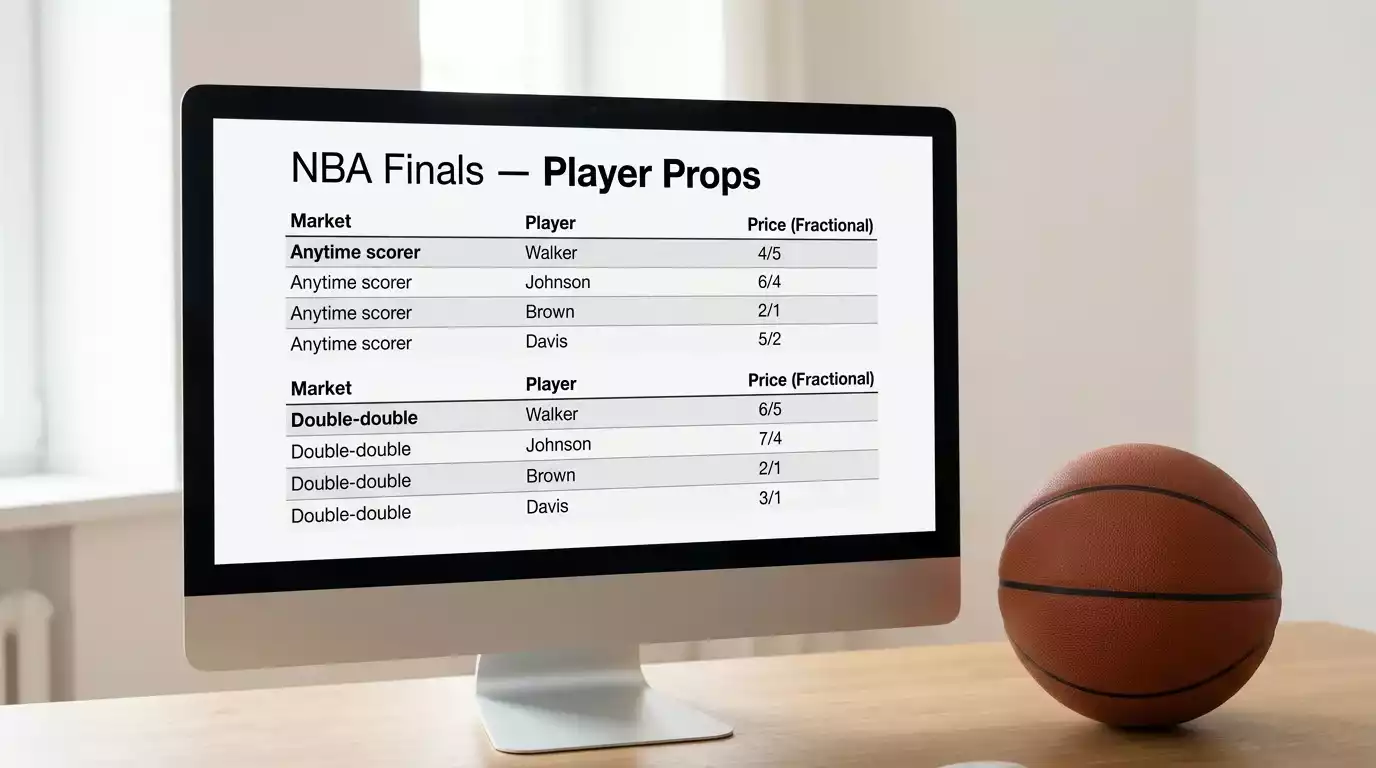
UK operators offer Finals props across four main families. First, the game-specific points/rebounds/assists over-unders: “Jalen Williams over 22.5 points,” “Chet Holmgren over 9.5 rebounds.” These are individual lines for one game, with prices typically clustered between 5/6 and 10/11 either way to give the book its margin. Second, the anytime-scorer market: a yes-priced bet that a specific player scores at least one bucket in the game. Third, double-double and triple-double yes/no props. Fourth, series-long markets: most points in the series, top rebounder, series MVP-adjacent props.
Bet365 and Paddy Power typically lead with the over/under points line because that’s where the volume lives. William Hill carries the same lineup plus a heavier promotional layer on anytime-scorer for the first game of each series. Sky Bet leans into double-double markets. Smaller UK operators run a thinner prop board overall, often skipping the series-long markets entirely because the long-hold liquidity isn’t there.
For UK bettors, the practical implication is that no single book has the best price on every prop. You can be on bet365 for the Jalen Williams over and on Paddy Power for the Chet Holmgren double-double in the same game. Line shopping across at least two operators is the floor; three or four is the standard for serious prop bettors.
Anytime Scorer Explained
Anytime scorer is the prop UK casual bettors back most often, and the prop UK sharp bettors rarely touch. The market asks a binary question: will this player score at least one field goal? For an NBA Finals starter the answer is “yes” with probability above 95%, so the prices are necessarily short: 1/14, 1/16, sometimes 1/20 for stars. Bench players get longer prices but still cluster between 1/6 and 1/4 if they’re seeing rotation minutes.
The reason sharps skip it is that the implied probabilities are too high to leave value on the table. A 1/14 anytime-scorer price implies 93.3% probability. To find value you need to believe the real probability is materially higher – say 97% – and even then your edge is small compared to the variance of getting it wrong (a star who fouls out early, a coach who rests a starter in a blowout).
Where the market gets interesting is on first-basket scorer or specific minute-bracket scorer props. First-basket is a niche derivative where the price compensates for the tighter window: a player who finishes 80% of games as the team’s first scorer might be priced at 7/1 instead of the 1/14 he gets on anytime. The variance is much higher, but the price actually reflects something interpretable rather than a near-certainty.
One distinction worth pinning down: anytime scorer is a yes/no market on at least one bucket, while points over/under is a continuous market on total points. The two markets answer completely different questions. A player can be priced at 1/14 anytime scorer and over 22.5 points at 10/11. You’d hit the anytime scorer almost certainly. You’d hit the over only when the player has a good night. Conflating them is a common mistake.
Series Scoring Leader
The most-points-in-the-series market is a long-hold prop that opens at the start of the Finals and runs to the final buzzer. UK books price it as a futures-style grid: one player at the favourite price (typically 6/4 or shorter for an MVP candidate), several second-tier candidates at 4/1 to 8/1, and a deep field at 16/1 and longer. The overround on this market is wider than most game-by-game props – often 20% or more – because the book has to price what is essentially a basketball mini-league across 4-7 games.
The 2025 NBA Finals between Thunder and Pacers averaged 10.2 million US viewers per game across the series – one of the lowest figures in 20 years – which gives a sense of how a quieter Finals can shape series-long markets. When the viewer numbers are down and the public is less engaged, the series-leader market becomes more efficient because there’s less casual money distorting the price. The 2025 Finals’ Game 7 alone drew 16.4 million viewers on average and peaked at 19.3 million, which shows how series-length variance affects every market that depends on cumulative volume.
Where the value occasionally sits: in the second-tier candidates. The favourite for series scoring leader is usually the team’s number-one option (Shai Gilgeous-Alexander for OKC, in this season’s case). At 6/4, that’s about 40% implied. But basketball variance is high enough that a number-two option averaging 25 points per game over 6 games can absolutely outscore a number-one averaging 28 points per game over 6 games, and the price on the number-two is often 9/2 (18%) – too long for the real probability.
Double-Double and Triple-Double Props
Double-double yes/no props are priced game-by-game for any player who regularly threatens the threshold. Nikola Jokic, when his team made the Finals, was typically priced at 1/4 or shorter to record a double-double (about 80% implied). A frontline player averaging 18 and 9 in the regular season might be priced at evens or 5/6 – meaning the book sees the real probability somewhere around 50-55%.
The structural issue with double-double pricing in the Finals: rotation tightening. Coaches play their starters more minutes in the Finals than in the regular season, which raises the floor of every counting-stat prop for those starters. A player averaging 18.5 points and 8.8 rebounds per regular-season game might be averaging 21 and 10 in the Finals just because they’re playing 38 minutes instead of 32. UK books usually adjust the price for this, but not always perfectly, and the slow adjustment on under-the-radar starters is where double-double value occasionally lives.
Triple-double markets are much longer prices because triple-doubles in the Finals are genuinely rare. Even an elite playmaking big is typically priced at 5/1 or 6/1 to record a triple-double in a specific game. Backing triple-doubles is a low-hit-rate, high-variance approach that I’d recommend only with the most disciplined unit sizing.
How the 2025 Integrity Case Reshaped Props
In October 2025, the US Department of Justice charged 34 people across two cases, with six charged in the NBA betting case, including Miami Heat player Terry Rozier and Portland Trail Blazers head coach Chauncey Billups. Rozier’s contract – worth $26.6 million – represents about 17% of Miami’s salary cap, and his salary was placed in escrow pending the outcome of the case. The reaction across UK sportsbooks was immediate: several operators paused low-liquidity player props (especially those involving lesser-known players), the Betting and Gaming Council and UK Gambling Commission both signalled increased monitoring of player-specific markets, and Bet365 narrowed its prop offering on bench-rotation players for several weeks.
Adam Silver, the NBA Commissioner, spoke to NBC News in October 2025: “There’s nothing more important to the league and its fans than the integrity of the competition. And so I had a pit in my stomach. It was very upsetting.” The phrase has become a kind of shorthand in UK gambling-industry meetings I’ve sat in, because it captures the exact mood of the regulatory response – protective, fast, and intolerant of ambiguity.
The practical consequence for a UK bettor in 2026: the Finals prop board is leaner than it was pre-2025. Star players are still fully covered, but the 11th and 12th players on the rotation get fewer markets, smaller stake limits and faster suspension when the line moves. That’s not a UK bettor’s loss exactly – those low-liquidity props were where the casino-style noise was loudest anyway – but it does narrow the field of available bets. If MVP markets are also on your radar, the parallel piece on NBA Finals MVP futures UK covers how voting-market dynamics overlay with player-prop pricing.
Are NBA player props still available on UK books after the 2025 integrity case?
Yes, but the offering is narrower than it was. Star and rotation players are fully covered with standard markets. Bench-end players see fewer prop types, smaller stake limits and faster suspensions when the line moves. UK operators added monitoring controls and tightened low-liquidity markets in the months after the October 2025 indictments.
How do anytime scorer props differ from over/under points markets?
Anytime scorer is a binary yes/no on whether a player scores at least one field goal in the game, typically priced very short for starters (1/14 or shorter). Over/under points is a continuous market on the player’s total points, with prices clustered around evens depending on where the line is set. They answer different questions and the variance profile is very different.
Prepared by the nba Final Bets editorial staff.