NBA Betting Implied Probability Chart and UK Shortcuts
 Available in US
Mental Math Shortcuts for NBA Betting Overrounds
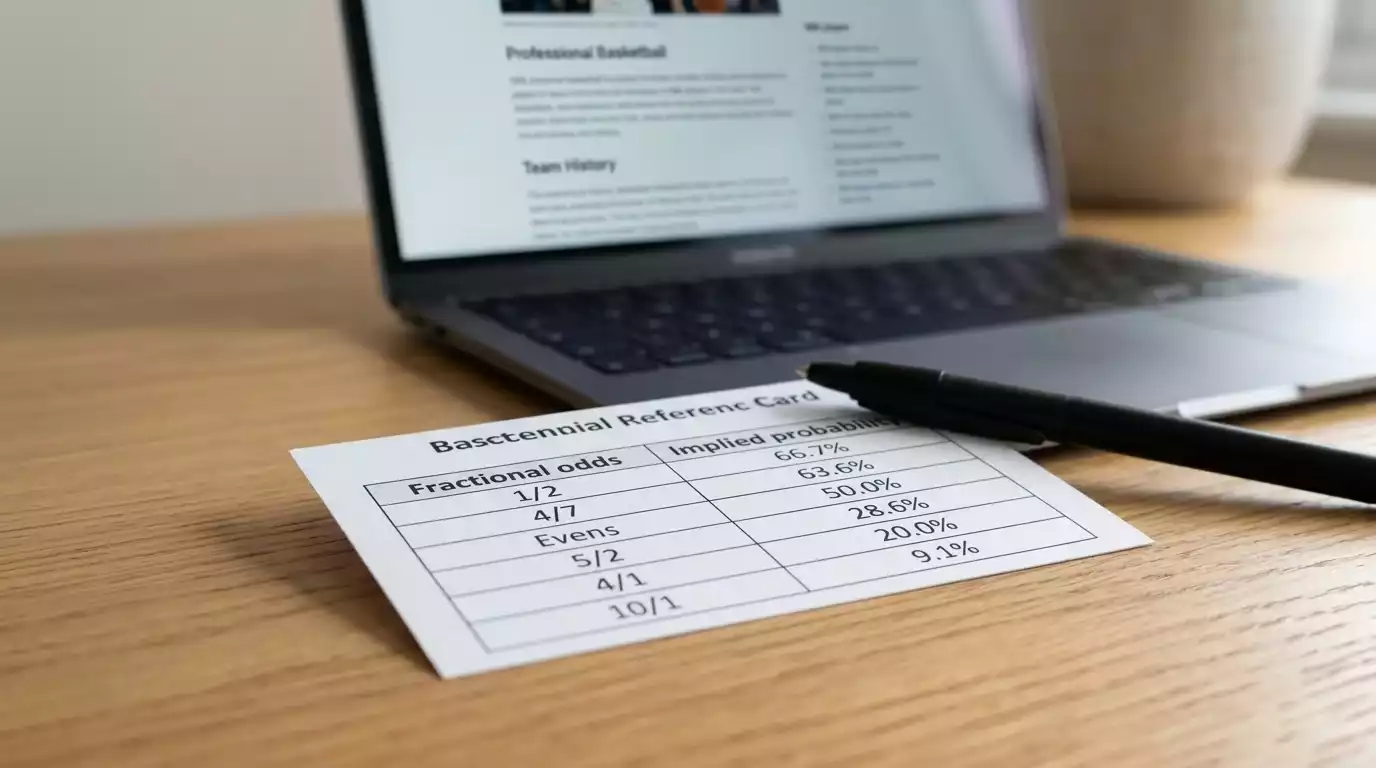
One of the smartest UK bettors I know – a former trader who now does this as a side project – keeps a laminated card next to his keyboard. On one side, fractional-to-percentage. On the other, decimal-to-percentage. He’s been betting fifteen years and could do the conversions in his head three times over. He still uses the card. Reason: at 02:45 BST when an OKC Thunder price has just dropped from 4/7 to 1/2, you don’t want to be doing arithmetic. You want to glance, decide, execute.
The card is a tool against fatigue, not ignorance. Implied probability is the underlying truth of any betting price, and once you’ve burned the conversion into reflex memory, your decision speed goes up by an order of magnitude. The 30 seconds you save per bet matter when there are 28 minutes between the final NBA injury report and the close of the pre-match window.
This article is the long form of that card: the core conversion table, the mental-math shortcuts that let you do without it when you have to, the way to read the current Finals board through it, and the overround adjustments that make raw implied probabilities less misleading on UK markets.
The Core Table
Memorising this table is the single highest-leverage 20 minutes a new UK bettor can spend. Here’s the spine of it, fractional with implied percentage in brackets, walked from heavy favourite through to longshot. 1/5 (83.3%). 1/4 (80%). 1/3 (75%). 2/5 (71.4%). 4/9 (69.2%). 1/2 (66.7%). 4/7 (63.6%). 8/13 (61.9%). 8/11 (57.9%). 5/6 (54.5%). 10/11 (52.4%). Evens or 1/1 (50%). 11/10 (47.6%). 6/5 (45.5%). 5/4 (44.4%). 11/8 (42.1%). 6/4 (40%). 13/8 (38.1%). 7/4 (36.4%). 15/8 (34.8%). 2/1 (33.3%). 9/4 (30.8%). 5/2 (28.6%). 11/4 (26.7%). 3/1 (25%). 7/2 (22.2%). 4/1 (20%). 9/2 (18.2%). 5/1 (16.7%). 6/1 (14.3%). 8/1 (11.1%). 10/1 (9.1%). 12/1 (7.7%). 16/1 (5.9%). 20/1 (4.8%). 25/1 (3.8%). 33/1 (2.9%). 50/1 (2%). 66/1 (1.5%). 100/1 (1%).
That’s 40 fractions, and the truth is you don’t need all of them at first. The 15 most-traded NBA fractional prices – 1/4, 4/7, 8/11, 1/1, 5/4, 6/4, 7/4, 2/1, 9/4, 5/2, 3/1, 4/1, 6/1, 10/1, 20/1 – cover 80% of what you’ll see on a Finals board. Learn those fifteen and the rest fills in by interpolation.
Decimal-to-percentage is mathematically cleaner: divide 100 by the decimal price. 1.50 = 67%. 1.80 = 56%. 2.00 = 50%. 2.50 = 40%. 3.00 = 33%. 5.00 = 20%. 10.00 = 10%. The relationship is symmetric and the maths is one division. Decimal is the format Pinnacle, Betfair Exchange and Smarkets use by default, and it’s worth being fluent in even if you bet fractional 90% of the time.
Mental Math Shortcuts
If you don’t have the card and you’re staring at an unfamiliar fractional, two shortcuts get you within a percentage point of the right answer in under five seconds.
Shortcut one – the flip trick for fractional. Fractional implied probability is denominator divided by (numerator plus denominator). Say it aloud once: “denominator over total.” So 4/7 is 7 over 11, which is roughly 0.64 or 64%. So 5/2 is 2 over 7, which is roughly 0.286 or 29%. You’re doing one division of small numbers, which is well within mental-math range.
Shortcut two – the friendly anchor. Pin five anchor prices in memory and interpolate from them: evens (50%), 2/1 (33%), 3/1 (25%), 4/1 (20%), 10/1 (9%). Almost every fractional you see sits within a tap of one of these. 5/2 is between evens and 2/1, but closer to 2/1, so it’s somewhere around 29%. 7/2 is between 3/1 and 4/1, so it’s about 22%. 11/2 is between 5/1 and 6/1, so about 15%. Speed matters more than precision when you’re shopping the line at 01:25 BST.
Shortcut three for decimal – the lazy divide. Memorise that decimal 2.00 = 50% and adjust from there. Every 0.10 up from 2.00 takes off about 2-2.5 percentage points: 2.10 ≈ 47.6%, 2.20 ≈ 45.5%, 2.50 ≈ 40%. Every 0.10 down adds 2.5 points: 1.90 ≈ 52.6%, 1.80 ≈ 55.6%, 1.50 ≈ 66.7%. Same logic for the longshots: every full unit of decimal above 3.00 takes off about 10 percentage points (3.00 = 33%, 4.00 = 25%, 5.00 = 20%, 6.00 = 16.7%).
Applying It to the Current Finals Board
The 2026 NBA Finals outright board is a perfect live exercise. OKC Thunder are trading at roughly -175/-180 on US books, which is around 4/7 fractional on UK books. The implied probability: 63.6%. The market thinks Thunder are odds-on. San Antonio Spurs sit at +300/+320, or 3/1 to 16/5 fractional – about 24-25%. New York Knicks at +550 is roughly 11/2 fractional – about 15%. Cleveland Cavaliers, having moved from +5000 to +2000 after a 125-94 Game 7 win over Detroit, now sit at 20/1 fractional – about 4.8%, up from the 2% implied at the +5000 opener.
Sum those five teams and you’re already at 113% implied. That’s the overround working – and the rest of the field (Celtics, Bucks, Nuggets, Lakers, Suns and so on) takes the total north of 130%. The overround on an outright market with thirty teams is structurally large because each tail-team carries its own juice.
The discipline: never compare your own probability estimate against the displayed price without first stripping out the overround. If a book shows Spurs at 24% implied and you think Spurs are a 28% chance, you don’t automatically have a bet. You have a bet if Spurs are a 28% chance and the overround-adjusted price implies less than 28%. The overround can be 15 percentage points of false signal.
Overround Adjustments and the Honest Probability
Stripping the overround out of a market is straightforward when you know how. Sum the implied probabilities of every outcome. Divide each individual probability by that sum. What you get is the bookmaker’s “true” probability – i.e. their estimate of the real chance of each outcome, before they marked it up to pay the bills.
Worked example: Thunder 63.6% + Spurs 25% + Knicks 15% + Cavaliers 4.8% + everyone else summing to about 25% = total 133.4%. Thunder’s overround-adjusted probability is 63.6 / 133.4 = 47.7%. That’s the market’s actual view of Thunder’s championship chance, not 63.6%. If you think Thunder are a 52% chance, you have value. If you think they’re a 45% chance, you don’t.
The implication: long-hold futures markets like NBA championship outrights are some of the worst markets for raw implied-probability comparison because the overround is so chunky. Single-game moneylines on Finals games are much tighter – the overround on a one-game market is typically 4-5% rather than 30%. That’s why the same Thunder team can look “expensive” outright and “fairly priced” in a single-game moneyline simultaneously.
UK Remote Gaming Duty rises from 21% to 40% from April 2026, and the new 25% Online Sports Betting Duty replaces the current 15% General Betting Duty from April 2027. Both will push UK book margins up, which means overrounds across NBA markets will likely widen over the next two years. The honest-probability adjustment matters more, not less, as those duties bite.
Building a Printable Version
The card I described at the top of this article is essentially the table from section two, formatted for printing on an A6 card and laminated. Fractional on the front, decimal on the back, with a column of corresponding American odds at the side. Sized to fit next to a keyboard or in a wallet, durable enough to survive coffee.
What to include if you’re making your own: the 20 most-traded fractional NBA prices with their implied percentages. The corresponding decimals. The corresponding American odds. A mini-formula for overround adjustment (“divide implied by sum of all implieds”). The fair-value reference points (50% = evens, 33% = 2/1, 25% = 3/1). And a single reminder line at the bottom: “compare to your own estimate, not to last week’s price.”
What to leave off: anything that requires arithmetic on the fly. The point of the card is to bypass calculation. If you’ve kept it short and dense and accurate, you’ll find yourself using it for the first month and then internalising it. After about three months of regular betting, you’ll only check it during fatigue moments, which is exactly what it was built for. For walking through the three odds formats themselves before you start memorising conversions, the longer companion piece is fractional, decimal and American odds in NBA betting.
What is the implied probability of 4/7 in NBA betting?
4/7 fractional implies a probability of 7 divided by 11, which equals 63.6%. The same price in decimal is 1.57, which gives 1 divided by 1.57 equals 63.7%. The tiny difference is rounding.
How do I adjust for the bookmaker’s overround when reading implied probability?
Sum the implied probabilities of every outcome on the market. Divide each individual probability by that sum. The result is the overround-adjusted probability that the book actually assigns to each outcome, before margin. On an NBA Finals outright with a 30% overround, raw implied probabilities overstate every team’s chance by roughly that proportion.
Written by the editors at nba Final Bets.