NBA Finals Correct Score Betting UK: Exact Series Odds
 Available in US
Pricing Exact NBA Finals Scorelines and Value
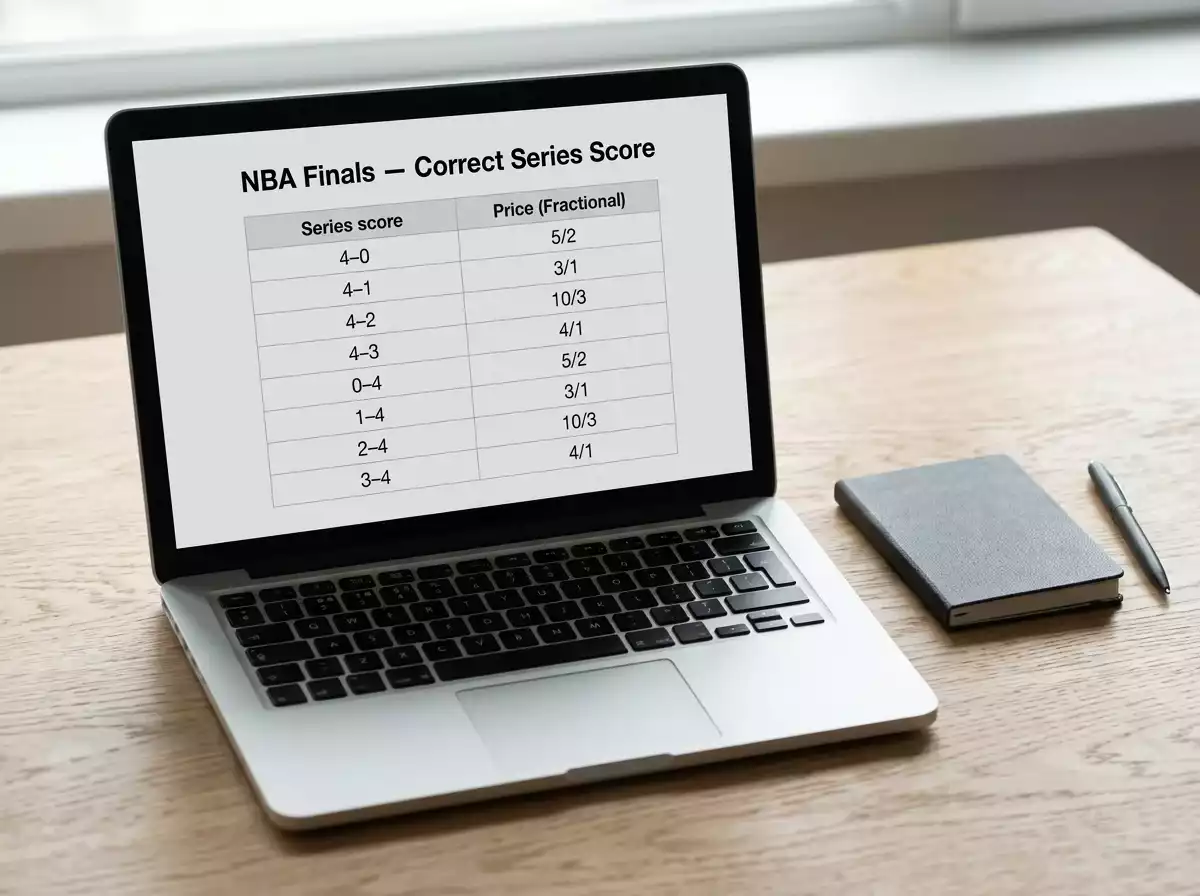
Correct-score on NBA Finals is the closest thing UK betting has to a haiku market. Eight outcomes – 4-0, 4-1, 4-2, 4-3 in each direction – sit on the grid, each carrying a number that tells a different story about how the series might end. The bet is uncompromising: get the exact scoreline right and collect the longest price on the slate; get within one game of the right scoreline and lose like you never had a stake.
I’ll be straight: correct-score is the highest-margin market a UK book runs on the Finals, often with a 15-20% overround across the eight prices. That’s twice what you’ll pay on a series handicap and three times what you’ll pay on a moneyline. So the floor for value is higher here than anywhere else on the board, and most of the time the right move is to walk past the market entirely.
But once or twice per playoffs, the distribution sits in a way the book hasn’t quite priced. A favourite with a soft route to the Finals but a long history of seven-game series. A specific narrative – coach versus former player, injury comeback, generational matchup – that pulls public money to one specific scoreline and warps the others. Those are the spots where correct-score earns its place in a UK bettor’s toolkit.
The Eight Outcomes, Explained
Best-of-seven gives the universe exactly eight ways to end. Either team can win 4-0, 4-1, 4-2 or 4-3. The shorter the scoreline, the rarer the outcome and the longer the price. 4-3 is by far the most-traded variant because the public reads it as “any close series” and money piles in. 4-0 is the rarest and is priced to reflect that – typical fair value sits at 10/1 or longer even for a heavy favourite.
Visualise the grid running top to bottom: Team A 4-0, Team A 4-1, Team A 4-2, Team A 4-3, Team B 4-3, Team B 4-2, Team B 4-1, Team B 4-0. Eight rows, eight prices, with the favourite’s 4-1 and 4-2 typically the shortest and the underdog’s 4-0 and 4-1 typically the longest. The book’s edge sits in the fact that the public over-bets the dramatic scorelines – Team B 4-3 against a Thunder-style favourite gets backed for sentimental reasons, not mathematical ones.
Worth noting: a few UK books also offer a “to win in 4/5/6/7 games” market that doesn’t distinguish between the two teams. That’s a different bet – you’re picking the length of the series, not the scoreline – and it usually carries a tighter overround because there are only four outcomes to price.
Historical Distribution Across NBA Finals
I’ve kept a rolling spreadsheet of NBA Finals scorelines since I started in the market, and the distribution is more uneven than the eight equal-feeling outcomes suggest. Across the modern era, 4-2 is the most frequent scoreline by some margin. 4-1 sits second. 4-3 is third and clusters around 20-25% of all Finals. Sweeps – 4-0 in either direction – make up less than 10% of historical results combined.
The last 4-0 was 2018, when Warriors beat Cavaliers. Before that, 2007 – Spurs over Cavaliers. Two sweeps in the modern Finals era spanning more than two decades. That base rate matters enormously when you see a sweep market priced at 5/1 or 6/1: the book is implying a 15-17% probability of an outcome that historically lands somewhere closer to 8%.
4-3 – the seven-game series – sits at about 23% across the historical sample. The narrative around it is bigger than its actual frequency. The most famous Finals – 2013 Heat over Spurs, 2016 Cavaliers over Warriors, 2024 Celtics over Mavericks, 2025 Thunder over Pacers – gives the impression that every Finals goes seven. They don’t. Roughly one in four does.
The dominant outcomes are the 4-1 and 4-2 results: efficient wins by the better team without the drama. Together they account for nearly half of all Finals scorelines. The implication for correct-score betting: if you don’t have a strong reason to pick the 4-3 or the sweep, the highest-probability slots are 4-1 and 4-2 for the favourite, and those are usually where the book’s price most closely tracks the historical base rate.
Pricing and Overround
Take a fictional matchup: Team A are 4/7 outright (about 64% implied probability) and Team B are 7/4 (about 36%). Eight correct-score prices need to sum to about 115% in implied probability for the book to run a 15% overround. Distributing that across the outcomes by historical base rate gives you something like: Team A 4-0 at 11/2 (about 15%), Team A 4-1 at 7/2 (22%), Team A 4-2 at 3/1 (25%), Team A 4-3 at 4/1 (20%), Team B 4-3 at 6/1 (14%), Team B 4-2 at 9/1 (10%), Team B 4-1 at 14/1 (7%), Team B 4-0 at 20/1 (5%). The sum is about 118% – slightly over the target 115%, which is fine because rounding to friendly fractional prices always overshoots.
The overround is the bookmaker’s structural edge, and on correct-score it’s punishing. UK Remote Gaming Duty rises from 21% to 40% from April 2026, with the new 25% Online Sports Betting Duty arriving in April 2027 to replace the current 15% General Betting Duty. The tax pressure on operators will likely keep correct-score overrounds wide or push them wider, since the market is high-margin enough to absorb the cost without driving customers away.
The line-shopping arithmetic on correct-score is unforgiving. A book showing Team A 4-2 at 3/1 might have a rival showing the same outcome at 10/3. That’s not a small gap – it’s the difference between 25% and 23% implied probability. Over a long-hold market with eight outcomes, those two-point gaps add up. The black-market story is also relevant here: the size of the illegal UK betting market hit £16.6 billion in 2025, more than three times the 2019 level, and offshore books push correct-score and exotic markets aggressively because that’s where their margins are best – but the consumer-protection gap means UK bettors have no recourse if they’re stiffed, so the rational route is line-shopping inside the licensed UK pool.
Value Spots Worth Watching
Where correct-score occasionally hides genuine value is on the favourite’s 4-2 line. The public loves the 4-3 narrative – every Finals is “going to be epic” – and that demand pulls money off 4-2 and into 4-3. A 4-2 favourite-side price that should theoretically sit at 3/1 sometimes drifts to 10/3 or 7/2 because nobody’s backing it. If your model says 4-2 is the modal outcome and the price is 7/2, that’s the kind of correct-score bet I’ll actually place.
The opposite trap: never back a sweep because the favourite is “looking dominant.” Recency bias is the single most expensive mistake on this market. A team that swept its conference finals is not more likely to sweep its NBA Finals – the opponent is better and the cycle of coaching adjustments is sharper. Sweep prices look juicy and almost never land.
Underdog 4-3 wins are a separate animal. The public under-backs them because the public over-respects the favourite. If your model says a Team B 4-3 happens 14% of the time and the price is 8/1 (11% implied), there’s a value sliver – but the variance on it is enormous and the loss frequency is brutal. This is a market for fractional Kelly staking, not flat betting.
Combining Correct Score With Your Outright Position
Correct-score becomes much more useful as a hedge against an outright ticket than as a standalone bet. If I’m sitting on a Team B outright at 7/4 placed pre-Finals, and the series gets to 2-2, I can buy a Team A 4-2 correct-score line at whatever the current price is to neutralise some of my downside. The maths gets cleaner because two of the eight outcomes are now eliminated (a 4-0 or 4-1 in either direction is no longer possible).
The trade-off is that the overround is punishing, so the hedge has to be priced against the alternative – a lay on Betfair Exchange – to make sense. Exchange commission is typically 2-5% of net winnings, which is much cheaper than the 15% baked into the book’s correct-score grid. The only times correct-score wins as a hedge is when exchange liquidity is too thin to execute at the size you need.
One workflow that’s served me well: when I place an outright at the start of the playoffs, I write down which correct-score outcomes I’d back at what price as a hedge if the series gets there. That way the decision is pre-baked. At 03:15 BST after Game 4, I’m not modelling distributions – I’m checking whether the price hits my pre-set trigger and executing. Anything I have to think about at that hour usually ends badly. For the underlying margin maths that fixes the favourite’s number, the deeper dive sits in NBA Finals series handicap markets.
How often have NBA Finals ended in a sweep this century?
Sweeps are rare. The last 4-0 Finals was 2018 (Warriors over Cavaliers), and the previous one before that was 2007 (Spurs over Cavaliers). Across the modern Finals era spanning more than two decades, sweeps make up less than 10% of all results, which is well below what UK books often imply with their sweep prices.
Is correct score better value than series handicap on NBA Finals?
Correct score has a higher overround than series handicap, typically 15-20% compared to 5-10%. So in pure expected-value terms, series handicap is the cleaner market most of the time. Correct score earns its place only when you have a strong view on the specific scoreline that the public is mispricing.
Created by the ”nba Final Bets” editorial team.