NBA Finals Series Handicap UK: Spread Betting Lines
 Available in US
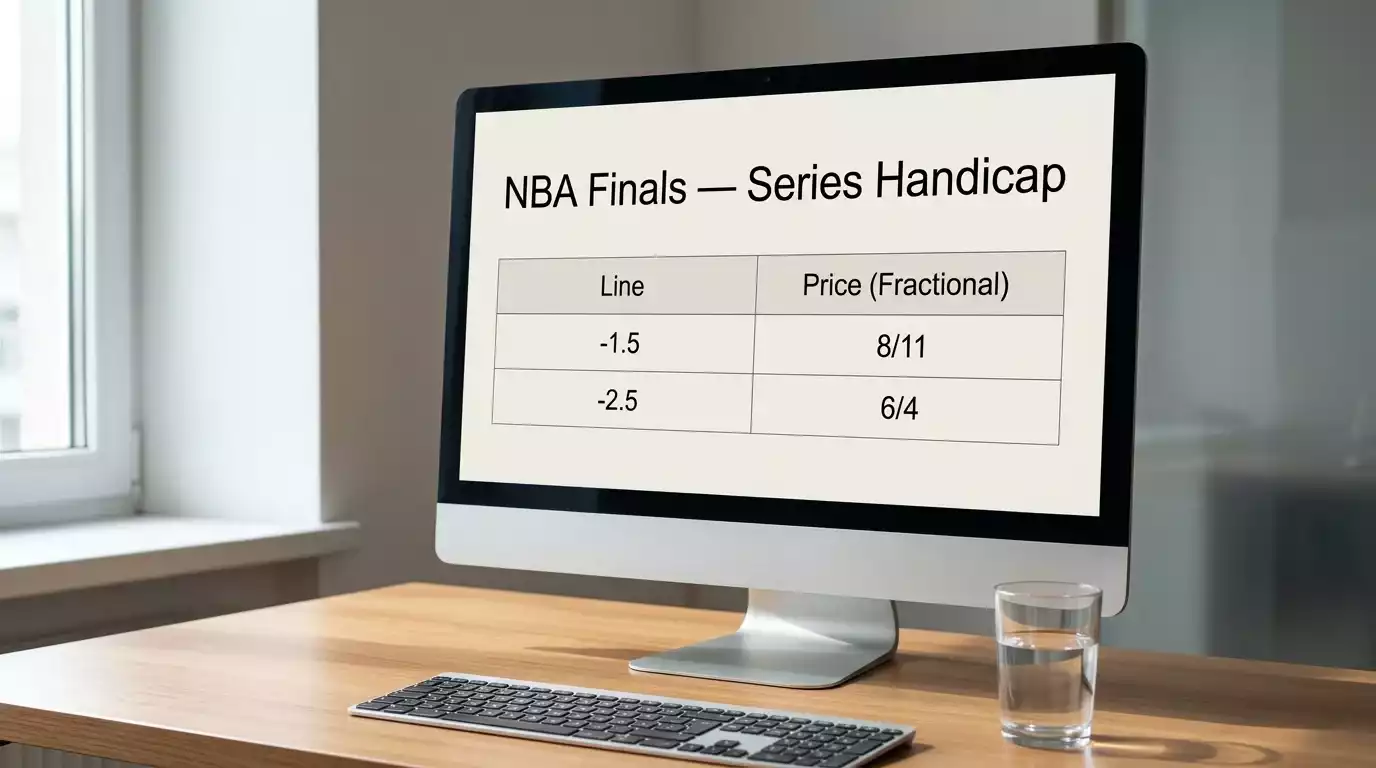
Evaluating Value in -1.5 and -2.5 Series Spread Lines
A reader emailed me last June: “If Boston are 4/9 to win the Finals, why is -1.5 series handicap on Boston paying 5/6? Are the books off?” The books were not off. He’d done what most UK bettors do their first time looking at series-handicap: read it as if it were a regular-season point spread for one game. It isn’t. The number you see is series games, not points, and the maths underneath is best-of-seven combinatorics, not single-game variance.
Series handicap shifts the price on a heavy favourite by demanding they not only win the series but win it by a specified game margin. -1.5 means the favourite must win 4-2 or 4-1 or 4-0 – anything that finishes with at least two more wins than the underdog. -2.5 raises the bar to a sweep or a 4-1, since 4-2 would only be a +2 game margin. Each step up the handicap lengthens the price, because each step removes outcomes from the winning set.
For UK bettors, this market is where short fractional prices on favourites – like 1/4 or 1/3 on the outright – get reshaped into prices that actually look like a bet. 1/4 on the outright says nothing; 5/6 on -1.5 series handicap says “we still think they win comfortably but the margin is not certain.”
The Series Handicap Lines You’ll See
Walk through a typical Finals board on a UK book and you’ll find four handicap variants offered: -1.5 / +1.5, -2.5 / +2.5, and on some operators -3.5 / +3.5. The -1.5 line is the most-traded by some distance because it captures the natural threshold between “comfortable win” and “scrap.”
Consider a fictional matchup: Team A are 4/7 outright over Team B. The book might price -1.5 series handicap on Team A at 5/6, and +1.5 on Team B at 10/11. The -2.5 line on Team A could move to 6/4 (more demanding margin, longer price), and +2.5 on Team B might come in at 1/2 (Team B just needs the series to reach Game 6 to land). The -3.5 line – which forces a sweep – typically prices at 10/3 or longer for the favourite, because sweeps are rare even when the gap between teams is wide.
The key insight: these prices are not independent. They have to be internally consistent with the outright price, because the same series result settles all of them. If you can model the probability distribution across the eight possible outcomes (4-0 Team A, 4-1 A, 4-2 A, 4-3 A, 4-3 B, 4-2 B, 4-1 B, 4-0 B), every handicap price falls out automatically.
That’s how the trading desks at UK books price these lines: they model the distribution first, then derive the handicap, the correct-score and the outright together. Which means inefficiency in one of those markets often shows up as a tiny mispricing in another – and that’s where line-shopping across operators starts paying off.
How the Maths Actually Works
Take the same fictional matchup and assume Team A win each individual game with probability 60%. Run the seven-game series as a sequence of independent coin flips with that bias (it’s not a perfect model – momentum and home court matter – but it’s close enough to show the structure). The probability of a 4-0 sweep is 0.6^4 = 12.96%. The probability of a 4-1 is C(4,1) × 0.6^4 × 0.4 = 20.74%. A 4-2 comes in around 20.74% as well. A 4-3 for Team A is roughly 17.28%. Total Team A wins: about 71.7%.
Now the handicap probabilities. Team A -1.5 (must win 4-2 or better) covers the 4-0, 4-1 and 4-2 outcomes: 12.96 + 20.74 + 20.74 = 54.4%. Fair price: 100 / 54.4 = 1.84 decimal, which is roughly 5/6 fractional. Team A -2.5 (must win 4-1 or sweep) covers 4-0 and 4-1: 33.7%. Fair price: 2.97 decimal, near 2/1 fractional.
The book then applies its overround – maybe 5-10% margin on a high-volume market like this – and what you see on the grid is the marked-up version of the same calculation. UK Remote Gaming Duty rises from 21% to 40% from April 2026, and the new 25% Online Sports Betting Duty arrives in April 2027 to replace the current 15% General Betting Duty. Both will pressure operators to widen the overround on lower-margin markets like series handicap, especially through the long-hold pre-Finals period.
The point isn’t that you need to run these calculations live. The point is that you can sanity-check a price by asking: does the implied probability of the handicap fit cleanly inside the implied probability of the outright? If a book is offering Team A at 4/7 outright (about 64% implied) but -1.5 at 4/5 (about 56% implied), the gap of 8 percentage points has to be the probability of a 4-3 Team A win. If your own model says 4-3 happens 15% of the time, the handicap is short by 7 points and you’d want the outright instead.
Historical Sweep Frequency and What the Number Hides
Sweeps in NBA Finals are rarer than UK bettors instinctively think. The last 4-0 was 2018, when Warriors beat Cavaliers. Before that, 2007. Across the 21st-century Finals window, you can count the sweeps on one hand. That’s the structural reason -3.5 handicap pays the prices it does – the market is correctly pricing 4-0 as a low-probability tail outcome even when the favourite looks dominant on paper.
Why so rare? Best-of-seven creates room for variance. Even a 70% per-game favourite has only about a 24% chance of completing a sweep. Add the fact that NBA teams adjust between games – coaching staffs are excellent at fixing what went wrong – and the longer a series runs, the less likely a one-sided result becomes.
For UK bettors this matters because UK operators occasionally offer eye-catchingly long prices on sweep markets that look like value but aren’t. A 5/1 fractional on a 4-0 favourite implies 16.7% probability. If your model says sweep probability is 12%, that 5/1 looks like value – until you realise that the book has been pricing this exact distribution for thirty years and probably knows the base rate better than you do. The opposite mistake – assuming sweeps are common because one happened recently – is even more expensive.
Home-Court Effect on the Handicap
Home court advantage in the NBA Finals isn’t a single Game 1 bonus – it’s a structural advantage across the 2-2-1-1-1 format. The higher-seeded team plays Games 1, 2, 5 and 7 at home, and Games 3, 4 and 6 on the road. That’s four potential home games to three. Historically, NBA home teams win about 60% of games in the regular season; the playoff number is closer to 58%.
What does that do to the series-handicap price? It tilts the distribution towards the higher seed in two specific ways. First, it raises the probability of a 4-2 or 4-1 win for the favourite, because the swing games (Games 5 and 7 if they happen) are at home. Second, it depresses the probability of a 4-3 outcome, because Game 7 – the variance game – is also at home.
The 2026 board reflects this. OKC Thunder, currently trading at roughly -175/-180 in US books and around 4/7 fractional on UK books, hold the regular-season tiebreaker against most of their potential Finals opponents because they finished with the best record. If they make it through, every series – including the Finals – starts at home. That’s why UK books are short on Thunder -1.5 series handicap relative to what their per-game probability alone would suggest. The 4-2 result is the most likely outcome, not 4-0 or 4-3.
If you’re looking at a Finals matchup where the home-court winner is the public favourite anyway, -1.5 is rarely good value: the book has the home court premium already in the price. If you’re looking at a series where the lower-seeded team has shorter outright odds for non-home reasons (better roster, better playoff record), -1.5 on the underdog with the road slate becomes a genuinely interesting market.
When Series Handicap Is Worth Backing
I bet series handicap in three situations and almost never outside them. First: when I think the outright favourite is correctly priced but the public is over-betting the sweep narrative, pushing the +1.5 underdog price out beyond its fair value. Second: when home court is in the underdog’s favour but the outright market hasn’t caught up. Third: when I’m hedging an existing outright position and the handicap gives a cleaner risk profile than a lay on the exchange.
I don’t bet series handicap on a tossup matchup, ever. Two evenly matched teams produce a near-uniform distribution across the eight outcomes, and the handicap doesn’t compress that variance into anything I can edge. Save your stakes for the lopsided series where the maths actually says something. The eight outcomes themselves and the long prices that hang off them get a fuller treatment in our piece on NBA Finals correct score betting.
How does -1.5 series handicap differ from -2.5 in payout terms?
-1.5 requires the favourite to win the series by at least two games (so 4-2, 4-1 or 4-0). -2.5 raises the bar: the favourite must win by at least three games (4-1 or 4-0). The -2.5 line carries a longer price because it removes the 4-2 outcome from the winning set.
Can I cash out a series handicap bet mid-series?
Most UK operators offer cash-out on series handicap markets between games. The offered price is typically marked down from theoretical fair value by 5-10% as the book’s margin on the buyback. Whether to take it depends on how the live margin compares to your own probability estimate.
Published by the nba Final Bets team.